
In this fascinating blog, Community Heritage Curator Steven Skelley shares the remarkable story of ‘Laura’, a mysterious stone head that has journeyed from a family garden in Green Moor to the collections of Barnsley Museums.
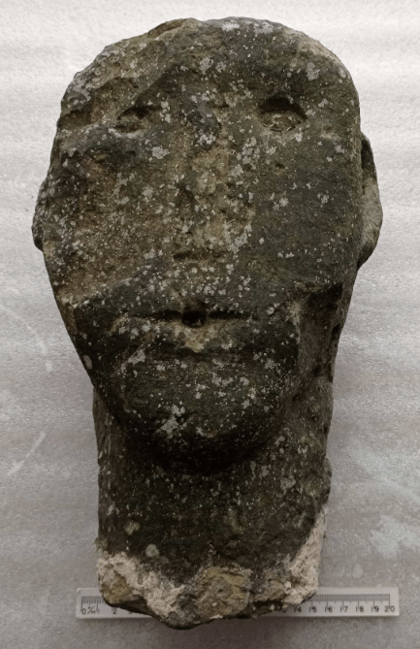

‘Laura’ the Green Moor Stone Head before conservation.
Where does the story of an ancient stone head begin? For the museum, it begins with Kath Squires, who, on behalf of the Davies family, brought an unusual stone head in for us to look at. In recent decades, Kath remembers this head perched in the rockery of her grandparent’s house, up in the dramatic hills of Green Moor, Barnsley.
As a girl, Kath thought the curious head to be a stone carving of her Great Grandmother, Laura Brown, and thus this head gained its name in her memory. The Davies family knew the head came from Laura and John Brown’s farmhouse even further up the hill at Don Hill. And before then possibly came from Laura Brown’s family smallholding in the same hilly area near an old stream. This takes ‘Laura’s’ story back to the turn of the 20th Century, but before then the origin of this stone head is a mystery.
At Experience Barnsley we love a mystery, it makes for a good story. So, with the support of the Portable Antiquities Scheme (who run quarterly archaeological finds surgeries in the museum) and other experts, we were able to tell the Davies family more about the head. This object is now recorded on the Portable Antiquities Scheme database with a reference of SWYOR-B56747.
Kath and the family were grateful for more clues as to Laura’s origin and thus they decided to kindly donate the head to the museum collections, in memory of their family but also as a gift to all the people of the borough. Another chapter of Laura’s story begins.
It can be difficult to date old stone heads; you can’t carbon date the stone itself (as it doesn’t contain carbon or organic materials). Dating is done by looking at the style of carving and the context of the head, such as where it was found. Some of the earliest heads from the pre-Roman, Iron Age period were often found near bodies of water, thought to have some spiritual significance. The earliest site attributed to this stone head is by an old stream which could offer a clue but this may also be misleading. Stone heads have often been moved from place to place, owner to owner, as people have been fascinated by antiquities for centuries. This is also true for what we know of Laura, being passed from Laura Brown down the generations of the Davies family.
This particular stone carving depicts a woman, featuring a long neck and a woman’s hairstyle. Her long, carved face is striking; her profile is almost completely flat and her expression ambiguous. At the museum we like to say she is like Leonardo’s Mona Lisa and that she doesn’t want to give her secrets away. Her features are also slightly drooping or twisted which can be indicative of ancient origins.
A long triangular wedge shaped nose is suggested but it does not project outward. Perhaps there was a longer nose once, but this has chipped off or been eroded on the windswept hills of Green Moor. Someone might have carved a triangle later, to make the best of her weathered features.
Laura’s eyes are unusual, and can be described as lentoid, or lens shaped, a feature of more ancient heads but again these may have been retouched. Her mouth features a ‘cigarette hole’, a deeper circular hole which is a consistent feature of pre-Roman heads. In other heads traces of incense has been found in these holes, suggesting a ritualistic purpose.
The hairstyle is carved with skill, displaying pronounced braiding held up in a bun at the back. Perhaps this offers us some hints, similar hairstyles can be seen in the Classical world and other Romano-British heads have a similar style. This might date the head to the 1st to 5th Centuries, but again this may again be misleading, as styles were often copied over the centuries with an interest in Classicism.
To further our research, Shelagh Hampton, a leading expert on stone heads, was kind enough to offer her expert advice. Shelagh noted that Laura’s hair had been ‘very carefully depicted with pronounced braiding and such a hairstyle precludes a pre-Roman date but seems very similar to a range of Roman female hairstyles’. Shelagh’s conclusions were that the head struck her as being unusual with its mixture of features, but it certainly is of considerable age. She didn’t want to risk suggesting an exact date but, in her experience, ‘this head stands a good chance of being medieval or early post-medieval. Perhaps it was carved in relation to a particular location? Common settings include farmhouses and wells where there is often apotropaic reasoning behind the siting’. She also thought the elegant long neck was indicative of a later date than the most ancient examples. Iron Age heads tend to have more squat necks, or none. Again, suggesting a date that is, at the earliest, Romano-British but probably later.
Could the head also represent an actual person, a landowner, religious figure or significant person from the area? This may fit with the Medieval origin theory, when heads were often carved of known people. Earlier Roman era heads also depicted local people but also Pagan deities, protective guardian spirits, or local folk figures. Another theory was that the head could depict national personifications like Britannia, but this was uncommon in more rural areas. Grand civic buildings being a more likely home for such figures.
Laura’s location is interesting; three hundred meters above sea level up in the hills where ancient farms have existed for millennia. Interestingly, Laura’s location was close to the famed hauntings of the Stocksbridge Bypass where ghost children in old-fashioned clothes were seen dancing under a nearby pylon, or a phantom monk is repeatedly witnessed, including by several police officers. Could Laura be a link to the phantom monk? or a clue as to the religious uses of this land many centuries past?

Action for Autism Barnsley, creative writing sessions with Raquel Vogl.

Folklore and has certainly inspired museum group Action for Autism Barnsley, who at the time of writing this blog are partaking in creative writing workshops to tell their own stories about who this head. From Aliens to Medieval nobles, the group’s imagination has run wild. Donor Kath Squires was generous with her time and joyfully sat talking to the group, pleased that Laura was inspiring creativity, as it had captured her own imagination before.


Laura and John Brown’s gloves and bowler hat respectively, which were also donated by the Davies family and studied by Action for Autism Barnsley in their sessions.
Where does Laura’s story take us next? After a recent bath (poor Laura had a lot of lichen growing on her) the carved details head were even more striking. Expert conservator Graham Key was fascinated by this object as he carefully cleaned and removed all organic material. The next step of our investigation is to find out if the stone used to carve Laura was indeed that of the local stone of Green Moor (which is particularly distinctive). This won’t tell us how old the carving is, but it might tell us if the head was always from these beautiful and windswept hills.
With the support of Barnsley Museums and Heritage Trust, the service was able to pay for Laura’s conservation and a bespoke metal worked mount (she is very heavy and can topple over). Laura will be on display safely in Experience Barnsley Museum later this summer for everyone to ponder on her story. Why not go and pay her a visit when she is on display?
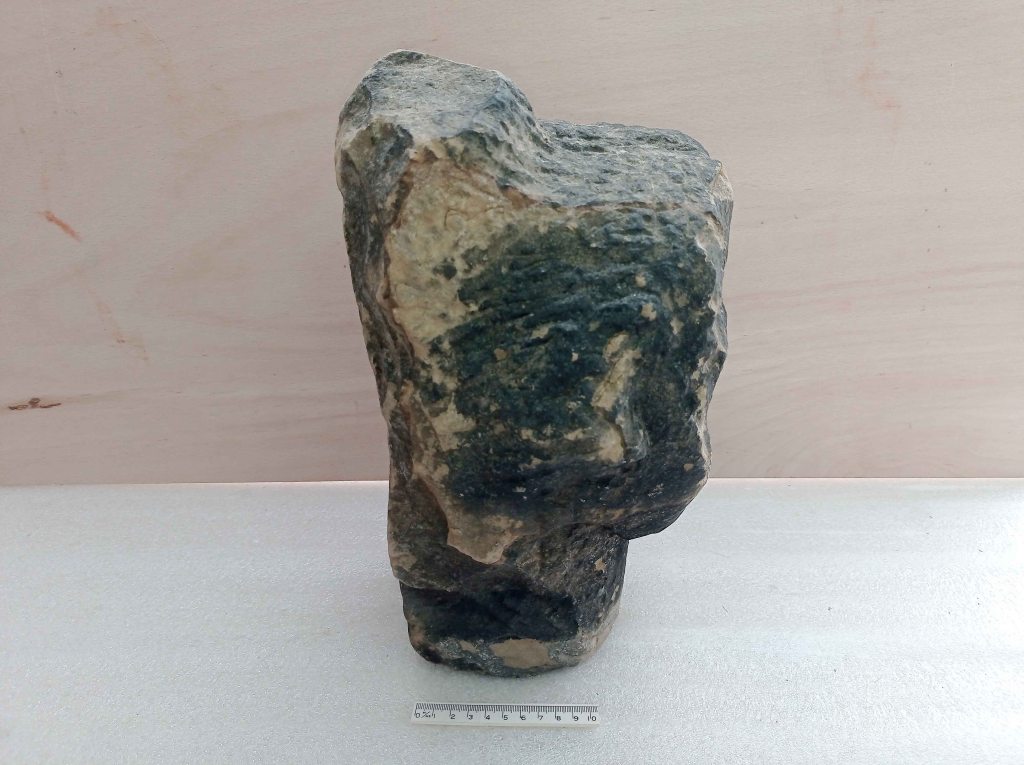


To conclude this blog, we leave you with the evocative words of Kath Squires who has written her own personal take on this object and that of growing up in Green Moor:
“For as long as I can remember, the ‘stooan ‘eead’ has been in the family garden. As a child I was fascinated by the carved head of a lady which lay on my grandparents’ rockery steps. No one was able to answer my questions as to her identity, except to say that she ‘came from t’ Dun (Don) Hill’ when my great grandparents, Laura (nee Watts from Dean Head) and John Brown, moved from a small holding (c.1950s). They obviously thought it significant enough to hand the carving to their daughter, Phyllis (my grandmother) in 1953. As a child, the association with my great grandparents led me to believe that this image was that of my great grandma. Laura died when I was about four (in ‘67) but I still remember her as a gentle dignified lady, in long dark skirts, with her hair in a bun (it was this hairdo that clinched the head’s identity for me).
If only this stone head could talk, what would she say of Green Moor and the family whose lives she observed? Of changing seasons: soft spring sunshine to bitter winter blizzards blowing in from Black Moor. Of hard physical labour in the mines underneath Hunshelf Bank, of chipping slag and working on local farms. Of learning the three Rs at Hunshelf School then on to Stocksbridge Secondary. Later to work at the sweet shop or chemist. Of a day for each household chore. Baking rhubarb pies, tarts and parkin. Then chapel three times on a Sunday. Of music – choir practice, pantomimes and Thurgoland dances. Of rationing, evacuees, US military personnel on Hartcliffe, blackout and listening fearfully for enemy planes as they targeted Sheffield. Of the Rock Inn, where nodding old men sat in flat caps, smoking pipes, ‘supping’ Stones’ bitter while children shared shandy and crisps by the village pump.
Yes, ‘Laura’ would tell us about all this, but there are some things that she will never reveal: who she was, who fashioned her, when, where and why will remain her secrets, forever.
The recent death of my aunt (Laura’s granddaughter) marked the end of an era – of the Davies family. It is time, therefore, to say goodbye to ‘Laura’ who has watched over our family and, for me, has come to symbolise our past. There is comfort in the fact that she will be cared for, and the people of Barnsley can take the opportunity to speculate on her life, her history and her mysteries.” – Kath Squires, 2026.
With huge thanks to Kath Squires and the Davies family for donating this wonderful object. Thanks also to Amy Downes of the Portable Antiquities Scheme, Shelagh Hampton for her expert advice, Graham Key for conservation, Raquel Vogl for creative writing, Action for Autism Barnsley for bringing Laura’s story to life, Rutherford & Wheeler for skilful museum mounting. And thanks to BMHT and Arts Council England for funding this project.
Read our previous blog for details about archaeological collections which are on display in Experience Barnsley Museum
 Barnsley Museums Blogsite