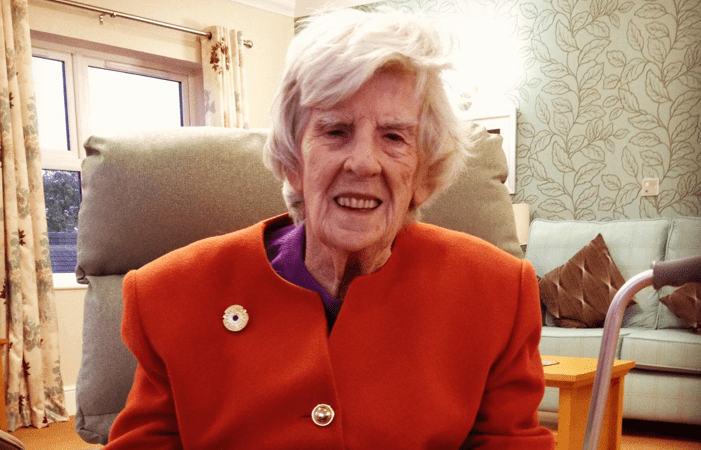
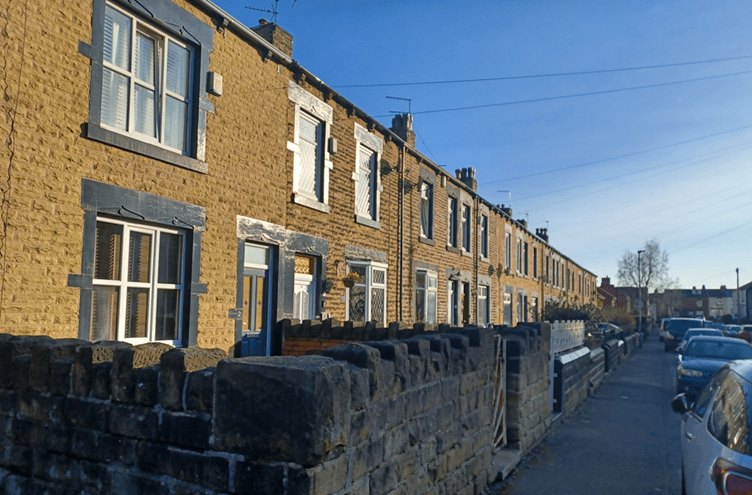
Margaret Hill (née Naylor, previously Weston) had a secret life in Buckinghamshire that she couldn’t share with anyone for many years. She was born in Spencer Street, Barnsley on 16 June 1921. Margaret and her first husband Walter both worked in secrecy at Bletchley Park, home to the Allied Forces codebreaking activities during World War II. Her story has recently come to light after a sound recording from 2011 of her experiences was catalogued and transcribed by Barnsley Archives and Local Studies as part of the National Lottery Heritage Fund ‘Remotely Digital’ volunteer project. David Blunden, Sector Specialist (Archives & Local Studies) shares her World War II story as part of our commemorations for VE Day.
Early years
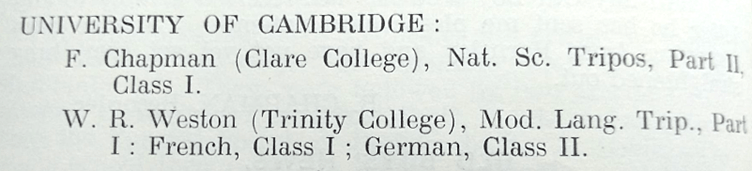
Margaret (known to her friends and family as Peggy) was born only three days before the census was taken in June 1921. She was the only child of John Henry Naylor and Frances Alice Naylor (née Hallam). Her father was born in Hoyland Nether and at the time of Margaret’s birth was employed by the Barnsley Corporation at the Electricity Works as a plumber and jointer of electrical cables. Her mother, Frances, is noted as being born in Mexborough and employed in ‘home duties’. It was while growing up on Spencer Street she met Walter Weston, who moved there with his family from Wombwell when he was eight. Margaret says in the recording that she and Walter were “childhood sweethearts” who later married on 5 January 1942 in St Edwards Church, Barnsley. Walter attended Barnsley Holgate Grammar School where he obtained a Borough Major Scholarship in 1938 to go to Trinity College Cambridge where he graduated in languages including French and German in 1940. At that time, the government was recruiting language graduates from universities to work at Bletchley Park to decipher foreign language codes. Walter was chosen for one of the jobs after a successful interview in Bedford and started at Bletchley Park in 1941.
Life at Bletchley Park
Margaret joined Walter at Bletchley Park during 1942, after applying for a job there. Like others Margaret had to sign the Official Secrets Act and if anyone asked about her job she would say that she was a “secretary”. She was stationed in the hut which was responsible for decoding Japanese messages. Margaret and Walter did not work together as he was working as a translator, first in Italian and then German as part of the deciphering of the Enigma messages. In her role, Margaret would work on maritime codes created by Japanese seaman on merchant ships. These codes would come in as four digit numbers which would then be cross-referenced from a working table to decipher the messages. In her interview from 2011 Margaret recalled what she did when she found important information:
“I always used to look through for ‘sensuikan’ and if I could see that in my message, I used to give it to the translator quickly because I knew sensuikan meant submarine”
Margaret’s translator was an army captain. They were the only two people working on that particular code (JN40) as other groups in the room would all be working on different codes. Each group did not know what the other was working on and messages were not discussed between the groups. Margaret also had a map of the Pacific Ocean where she would plot the location of Allied submarines and ships that the Japanese seamen had sighted. These sightings were transmitted by the seaman to their Japanese headquarters and these messages would be intercepted and decoded by the team at Bletchley Park.
One of Margaret’s most memorable moments during her work was when the site was visited by Prime Minister Winston Churchill. Margaret was asked if she would show the Prime Minister her map of the Pacific and how ships and submarines were pinpointed. At the end of the demonstration Margaret recalled the following was said:
“Churchill said “Carry on the good work”. Now I do believe he must have said it to thousands of people during the war.”
Margaret also remembers that there were a number of naval personnel who visited her office, particularly Admiral of the Fleet Sir James Somerville. Margaret recalled during the interview that he met his niece-in-law for the first time in the office. At the time a lot of people who had married during the war hadn’t always met their extended family due to wartime commitments.
Leisure time
Aside from her work in the office, Margaret mentioned that usually workers were given one day off a week. If a working day fell on a Sunday staff were allowed to have 45 minutes off to go to church. She gave an insight into other areas of life at Bletchley Park including how food was provided and social events. Margaret mentioned that she preferred the salads, but as they were rationed certain combinations were forbidden:
“The salads were cabbage, chopped carrots, [or] grated carrots, bit of onion. If you had cheese you couldn’t have egg…some tomato. It was all rationed, in a way, in that there were big dishes where they had waitresses behind the tables to see that you didn’t get what they considered to be too much.”
Margaret also recalled how “lovely” the gardens were at Bletchley Park and how it was the first time she had seen magnolia trees. She would regularly have her lunches in the gardens which also contained a large pond. As the workforce at Bletchley Park expanded, an increasing number of social events were organised. Margaret remembers Scottish dancing classes and tennis courts being constructed. Her most notable memory was when pianist Dame Myra Hess, who was well-known for organising wartime concerts, played there:
“It was absolutely magical, absolutely magical, you wouldn’t believe that anybody could get out of a piano what she did. That one I can particularly remember.”
Margaret left Bletchley Park in 1944 after becoming pregnant to have their daughter Pam. Towards the end of the war Walter was transferred to Eastcote on the outskirts of London, also known as HMS Pembroke V. According to Margaret this was due to Germany having surrendered and Walter needing to have a “six week crash course in Japanese” as the Allies were still at war with Japan. The war in East Asia ended on 2 September 1945 signifying the end of the Second World War, although Walter continued to work at Eastcote until 1946.
Returning to Barnsley

Walter and Margaret returned to Spencer Street in late 1947 before moving to Wombwell to help run Walter’s family business. Sadly, a few months later in early 1948 Walter fell ill with cerebro-spinal fever and died, leaving Margaret to look after their two year old daughter. Margaret later remarried but had to keep the events of Bletchley Park to herself until the 1970s when the stories started to be talked about in wider society. Although her second husband had also died by this time and never got to know about her life at Bletchley Park, Margaret recalled her children’s reactions when they found out:
“They were absolutely surprised and delighted because it was believed that it had shortened the war by two years.”
In 2009, Margaret, along with all surviving workers, was officially recognised by being entitled to apply for a commemorative badge issued by the UK Government. Another medal was also received from the Bletchley Park Trust. Margaret and Walter are both remembered for their work and appear on the Bletchley Park Roll of Honour which includes a summary of their duties. You can listen to the complete interview with Margaret Hill as part of this blog.

 Barnsley Museums Blogsite