The four year Eldon Street HSHAZ may have come to an end earlier in the year, but we’re hoping that it’s legacy will continue for many years to come. In partnership with Barnsley Civic Trust and following extensive research in Barnsley Archives and Local Studies in the last few years, five blue plaques have now been installed on and around Eldon Street celebrating people and buildings connected to the historic high street.
This blog written by Michael Hardy (Digital Engagement Curator) brings together research and other blogs by Dr. Tegwen Roberts (HAZ Project Officer) and David Blunden (Community Sector Specialist)
Catherine Mawer
Catherine Mawer (1803-1877) was a master sculptor and stone mason based in Leeds in the 19th century. As a woman working in a male-dominated profession, she was highly unusual for her time.
She established a successful stone-yard and studio with her husband Robert. After Robert’s untimely death in 1854, she continued to run the business on her own, eventually founding the Mawer group of architectural sculptors with her nephew William Ingle and three apprentices – Benjamin Payler, Matthew Taylor and her son, Charles Mawer.
Her incredible legacy in shaping some of Leeds landmark buildings, including Leeds Town Hall, has been celebrated in recent years, but her mark on Barnsley is less-well known.
Under her guidance, the Mawer group created beautiful carvings for two iconic Barnsley buildings; the Barnsley Mechanics Institute and Public Hall (now the Civic, Barnsley) and the Queens Hotel on the corner of Eldon and Regent Street. Their work still gives Eldon Street much of its character, although it often goes unnoticed by passers-by.


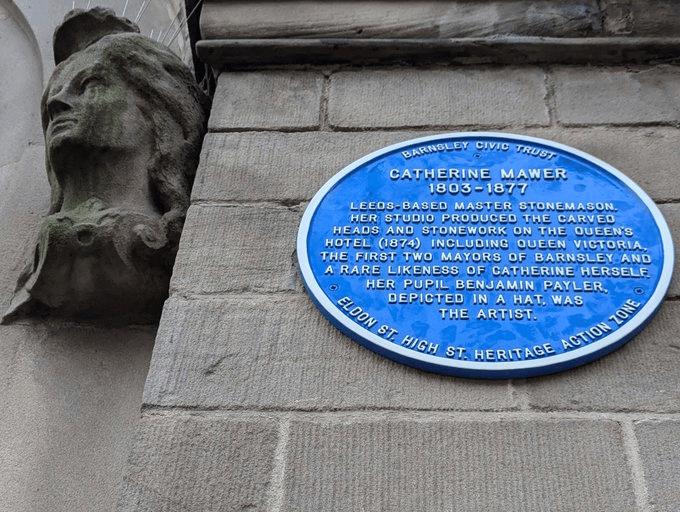
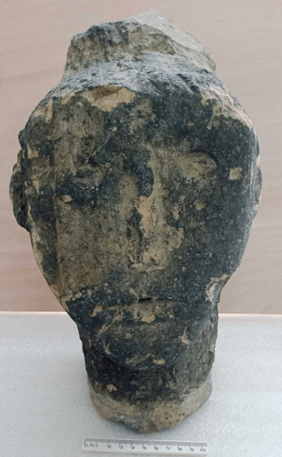
The heads include Queen Victoria, the first two Barnsley mayors, Catherine herself and one of her pupils, Benjamin Payler. The identity of the other heads on the Queens Hotel is not known, but they are likely to include local dignitaries and possibly characters from well-known plays or theatre productions. We believe at least one is of a member of the Fox family.
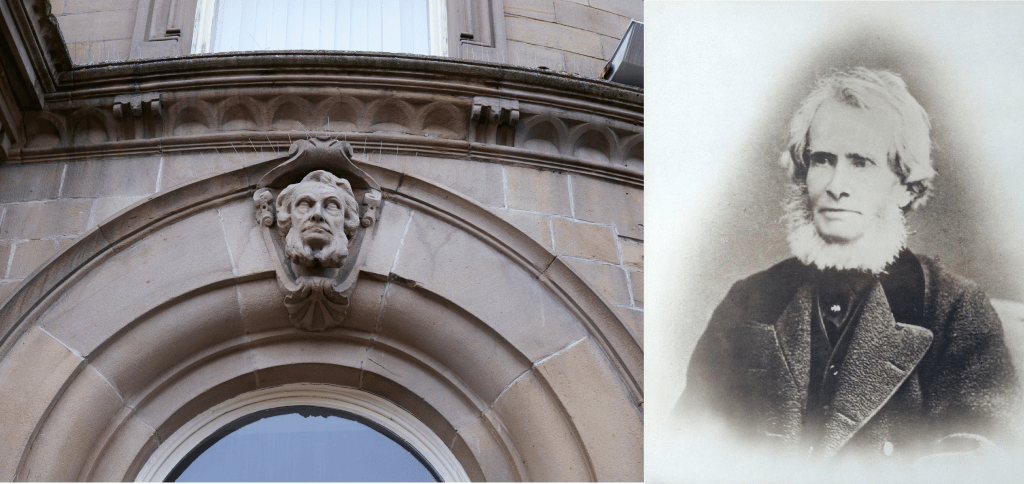
Because of the challenges of transporting ornate carvings, the stones would be roughed out by stone masons away from site, and then incorporated into the building unfinished. The sculptors would then finish the carvings in-situ using ladders and scaffolding, in full public view. It would have been quite a spectacle!
In 2022 the work of Catherine Mawer was celebrated in an exhibition at The Cooper Gallery ‘Queen of The Stone Age’ was a photographic exhibition by Andrew Wall an Architectural Photographer. See all the photographs from the exhibition.
(Subscribe to our blogsite to be the first to receive new articles direct to your inbox!)
John Whitworth
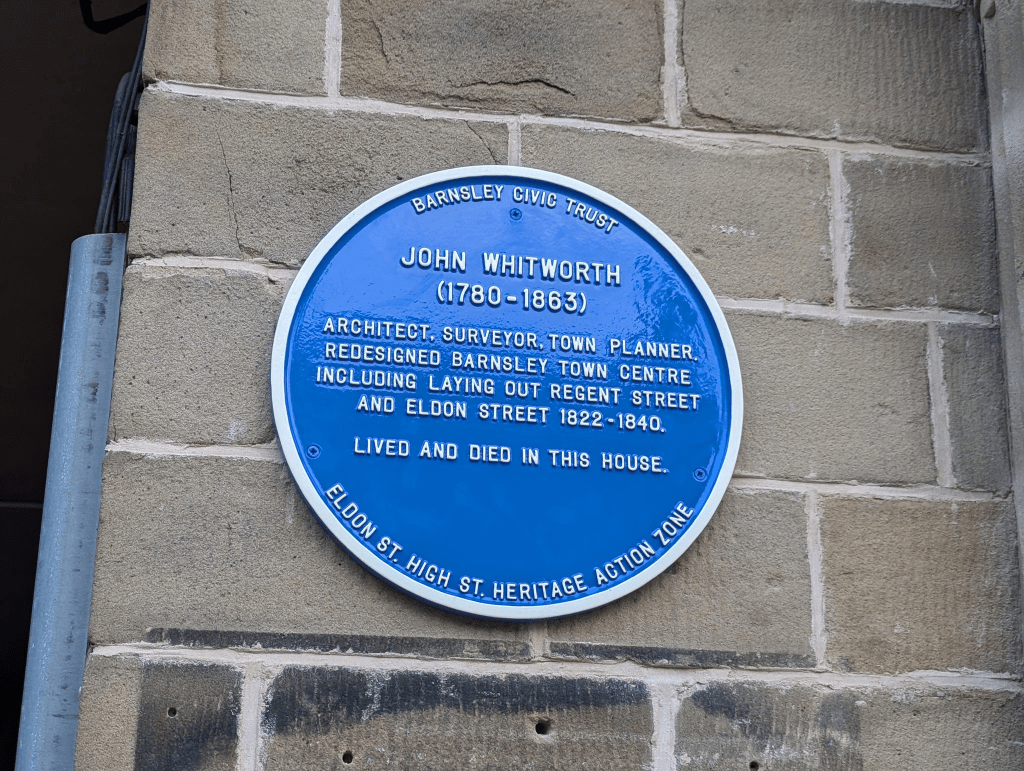
John Whitworth (1780-1863) was a Town surveyor appointed by Barnsley Corporation under the Barnsley Improvement Act of 1822. He helped to redesign Barnsley town centre in the 1830s and 1840s, laying out wide new streets including Regent Street, Pitt Street and Eldon Street on the edge of the town’s medieval core.
Born on the premises opposite the Corn Exchange, later held by Mr. Butterfield, at the top of Market Hill, where his father carried on the business of a saddler and which he continued the business until 1844
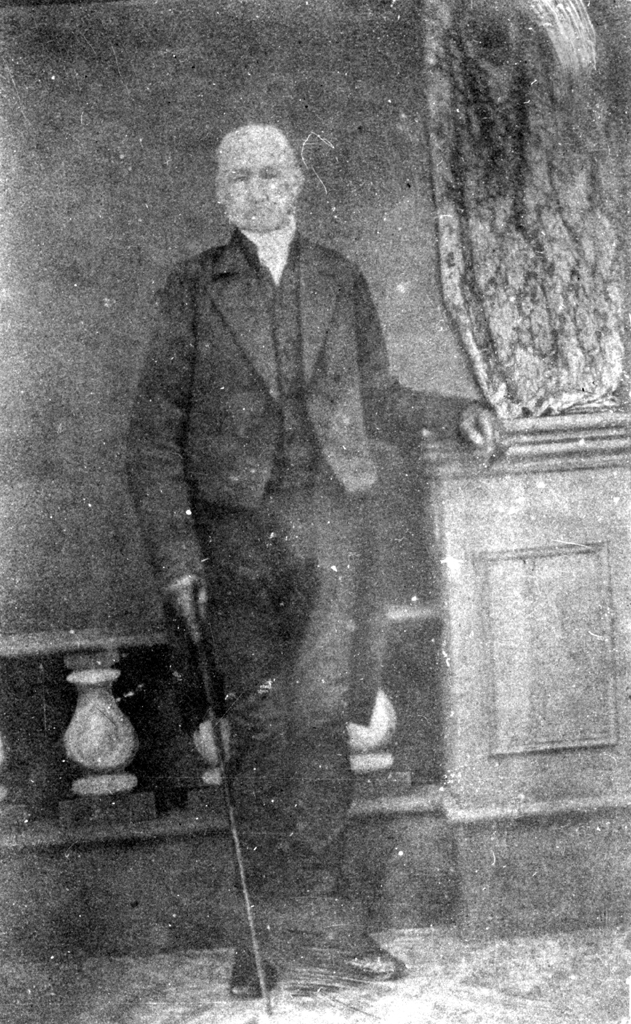
It is estimated that forty chapels in and near town were built from his designs, including Westgate and Pitt Street Wesleyan Chapel. His other designs included all the turnpike roads in the area from 1810 onwards, among others “the Cutting” between Barnsley and Worsbro’ Dale, and the new roads which enter the town from Dodworth, Darton, Hoyle Mill, and Old Mill. Cockerham.
He levelled Shambles Street, and gave Market Hill its present appearance, by removing the Moot Hall and by raising the lower portion near Sough Dyke. In 1848 he valued the rateable property in the town for the Overseers, the amount of his valuation being £34,000. Whitworth was a Wesleyan, and also a director of the Barnsley Banking Company. He died January 27th, 1863 aged 83.
Ann Porter
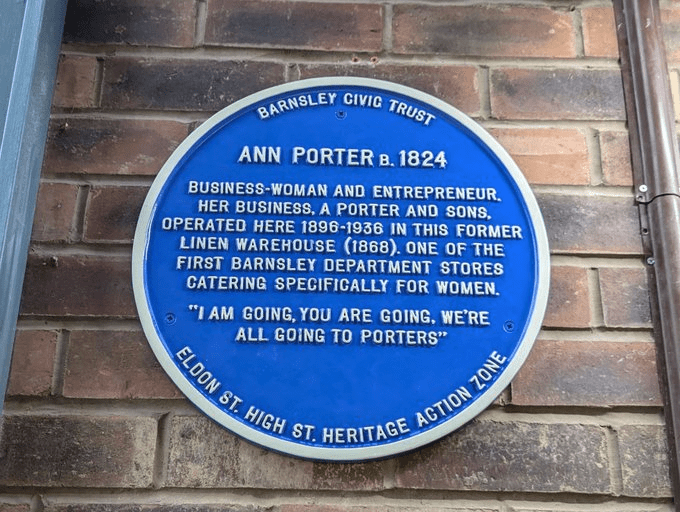
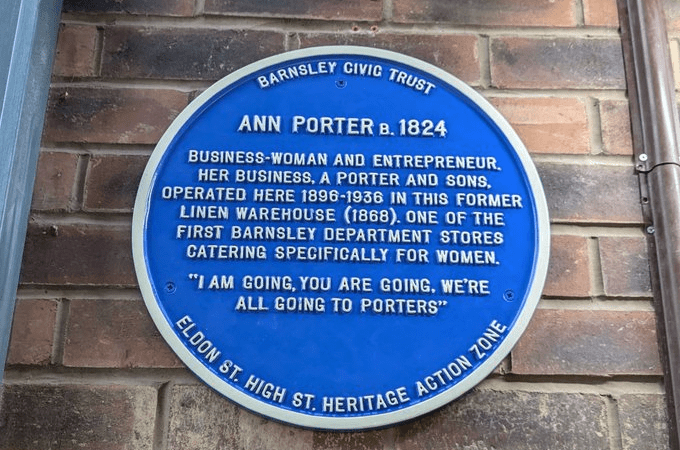
Ann Porter (1824-) Businesswomen and entrepreneur, founder of A. Porter’s and sons, one of Barnsley’s first department stores catering specifically to women. Rather than inheriting a family business, Anne is unusual in that she set up her business after her husband, Benjamin Porter – a gas maker, died in the 1870s. By the 1881 census, Anne (who had five children) is recorded as a widow with a shop on Sheffield Road. She moved the business to larger premises at 58 Eldon Street (now Lesley Francis hairdressers) in 1896. Porter’s offered ‘Everything a lady wears and most thing for the home. at cheaper prices than can be found elsewhere.’

Ann’s story shows the sorts of social and economic opportunities there were for widows during this period. For some women it was a necessity, but for others it was an opportunity to set up business freely and independently in a way that married women were often unable to do. Another notable thing about Porters is that, although Ann did not use her full name, their advertising was bold and ambitious, with regular adverts in the local papers, challenging the idea that women business owners were not prominent, or keen to draw attention to themselves, at this time.
Porters closed in 1936 and the ground floor of the building was split into two. The two new units (58A and 58B) were occupied by G Burnett and Sons (decorators supplies) and Bessie Evans (women’s fashion).
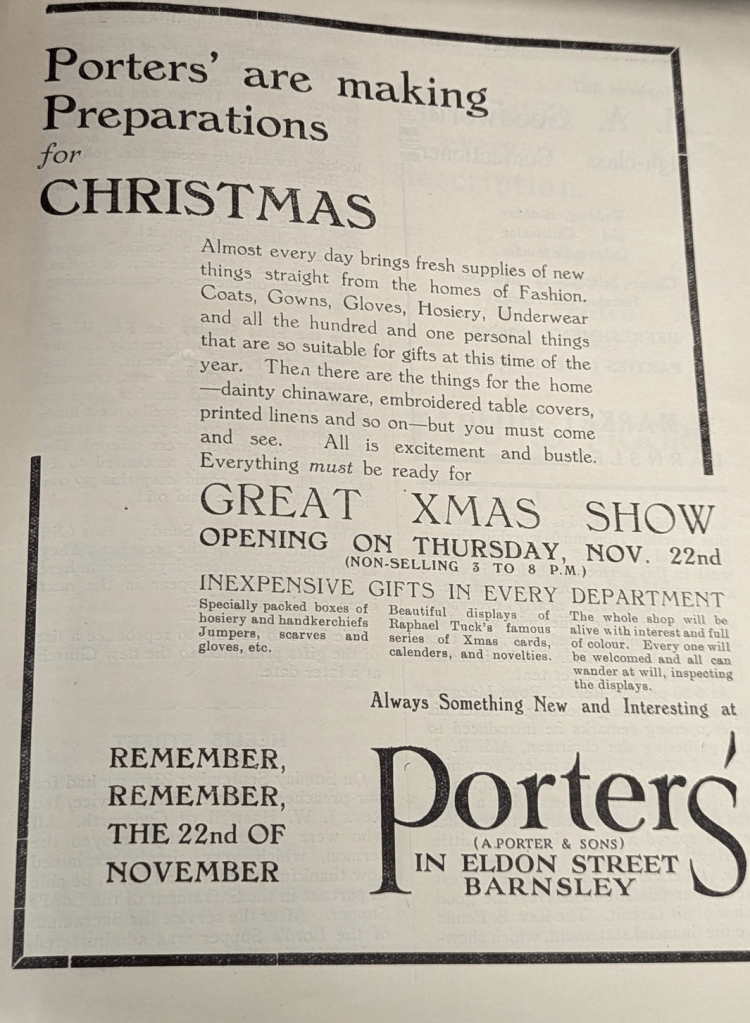
Ann Porter also featured in our Women of Business Owners of Eldon Street animation and blog
Read more about 58 Eldon Street
Thomas Lister
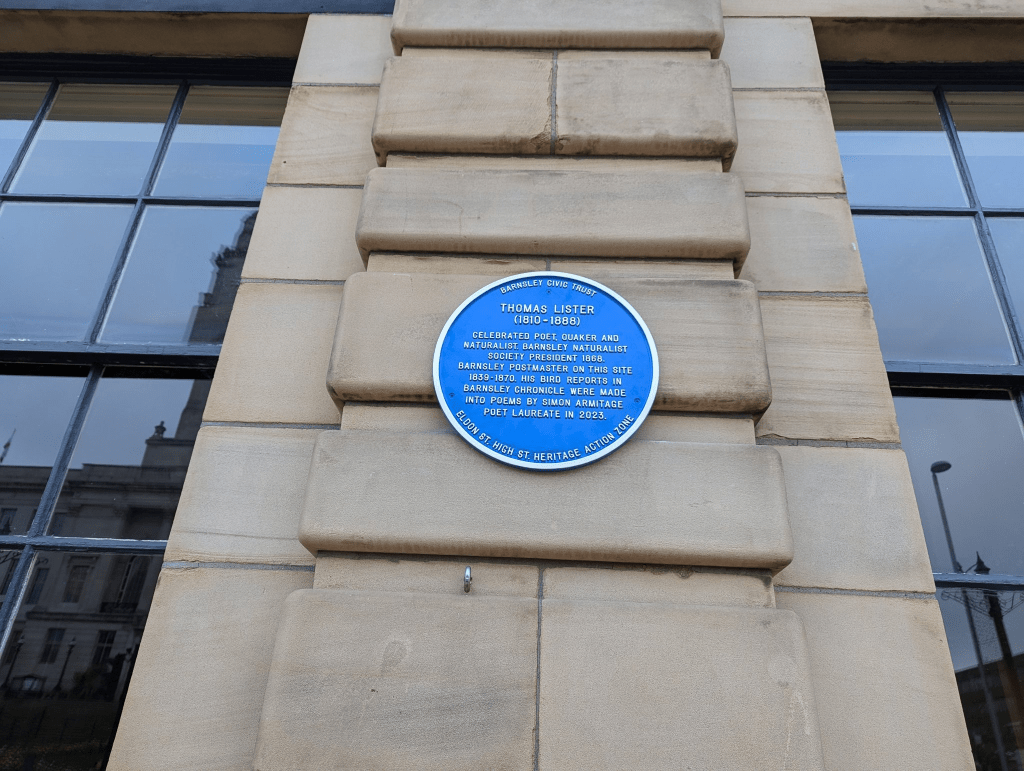
Thomas Lister (1810-1888) Poet, Postmaster and Naturalist. Born at Old Mill Wharf, near Barnsley,11th February 1810 he was the youngest of fourteen children. He was educated at the Quaker Friends’ School, Ackworth, between 1821 and 1824 where he is said to have received a good English education. He was admired for his athletic feats and physical courage.
He initially refused to take the postmaster position as he was required to swear an oath, which as a Quaker he declined to do on religious grounds. He was later offered the position again without the oath, which he accepted.
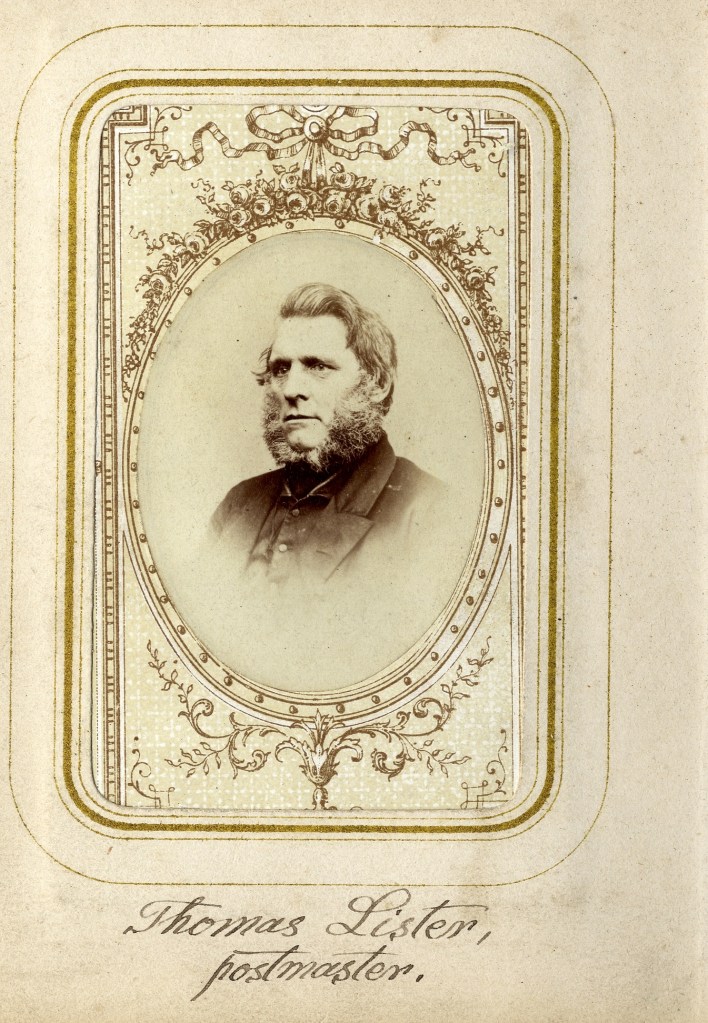
Thomas was also president of the Barnsley Naturalists for many years, and his lists of local bird sightings and meteorological observations were regularly published in the Barnsley Chronicle.
“Thomas Lister’s long connection with the society has been the chief factor in making the museum rich in the department of ornithology”
He published a series of poetry books, including Rustic Wreath (1834) Temperance Rhymes (1837) and Rhymes of Progress (1862). He was known for reciting his poems at meetings and public events, including at the opening of Locke Park and the foundation stone ceremony for the Public Hall on Eldon Street. Barnsley Archives have lots of his work, take a look the next time you visit.
It’s in Barnsley Archives where we found a lengthy obituary for Thomas Lister, which was published in the Barnsley Chronicle, it was noted at the time that more of the weekly newspaper would have been devoted to Lister but other events had prevented that happening and they would address that in the coming weeks.
(Click the image for a larger view of the obituary)
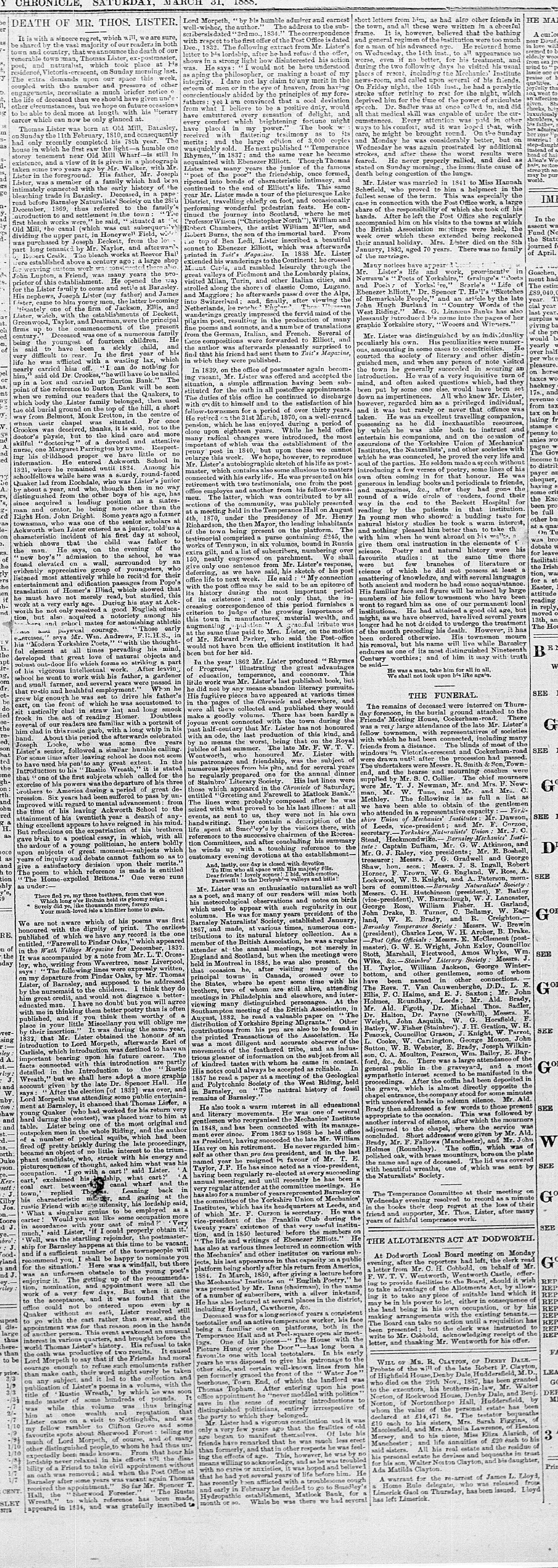
The length of the article and the turnout at his funeral is testament to the impact Lister had on Barnsley and beyond; “His townsman mourn his removal, but his name will live while Barnsley endures as one of its most distinguished Nineteenth Century worthies” Lister was also well travelled and in 1838 visited France, Italy, Switzerland, and the Netherlands, it was his writings from this trip that bought him to the attention of Ebenezer Elliott, ‘the corn law rhymer’ and lead to his work being published in ‘Tait’s Magazine” Elliott and Lister became friends and he wrote two poems about the post-master;
“Yes, Lister! bear to him who toils and sighs
The primrose and the daisy, in thy rhyme;
Bring to his workshop odorous mint and thyme;
Shine like the stars on graves, and say, Arise,”
Read the full poem and other literature by Lister here
When Poet Laureate, Simon Armitage took up residency as part of the HAZ and was inspired by Thomas Lister and the Barnsley Naturalists. You can listen to ‘An Unnatural History’ an album by his band LYR and find out more about the residency on our website.
The HSHAZ also worked with Barnsley street theatre company Mark Mark Productions to create the ‘Barnsley Unnaturalists Wonders of Eldon Street’
Matthew Wardhaugh and Eliza Wardhaugh
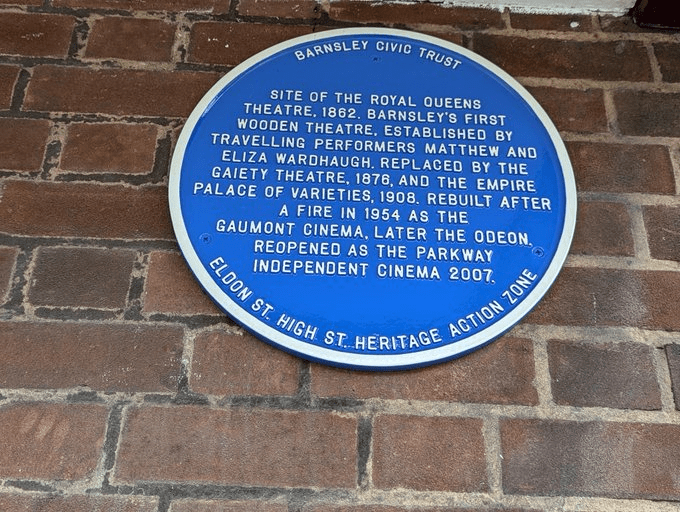
Matthew Wardhaugh (1813 – 1868) and Eliza Wardhaugh Theatre proprietors. Matthew and Eliza established a wooden theatre, the Royal Queens Theatre in 1862.
Matthew started work as a call-boy in Drury Lane, London. He later travelled England and Scotland performing from a van, which served as a travelling theatre. He established a more permanent wooden theatre in Longton in 1854, and with his wife Eliza went on to establish three more wooden theatres across the North of England, including the Royal Queens Theatre in Barnsley.
The Royal Queens Theatre opened under proprietor Matthew Wardhaugh in December 1862. An advert was placed in the Barnsley Chronicle on November 19, 1862 to announce the opening.
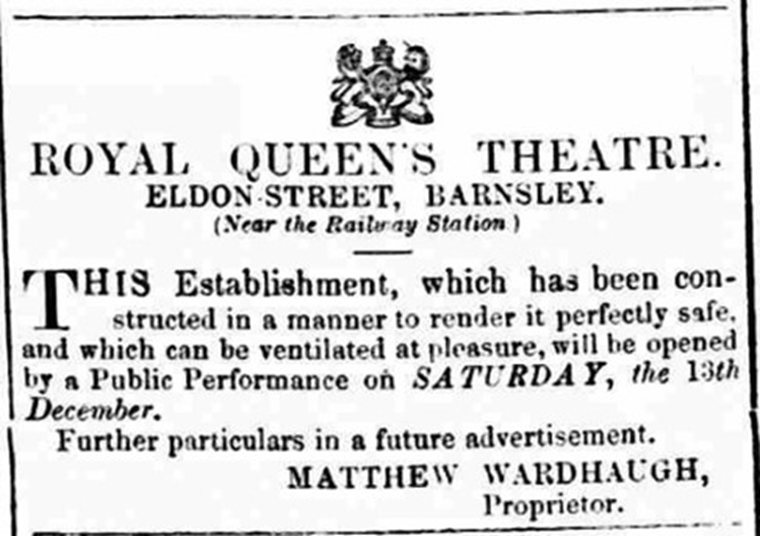
the opening advert suggests that the public might be expected to view a wooden theatre with a degree of suspicion, particularly from a safety point of view. However, the Royal Queens Theatre apparently thrived, continuing to advertise shows in the local papers throughout the late 1860s and early 1870s. The shows were a mix of drama, farce and comedy, featuring both Matthew and Eliza Wardhaugh with visiting guest variety acts (such as Henry Smith and his Gigantic Diorama of America in 1863). Newspaper adverts listed different shows every night, including Christmas Eve and Boxing Day (in 1862). Although no plans of the theatre survive, the adverts give ticket prices for private boxes, side boxes, pit and gallery.
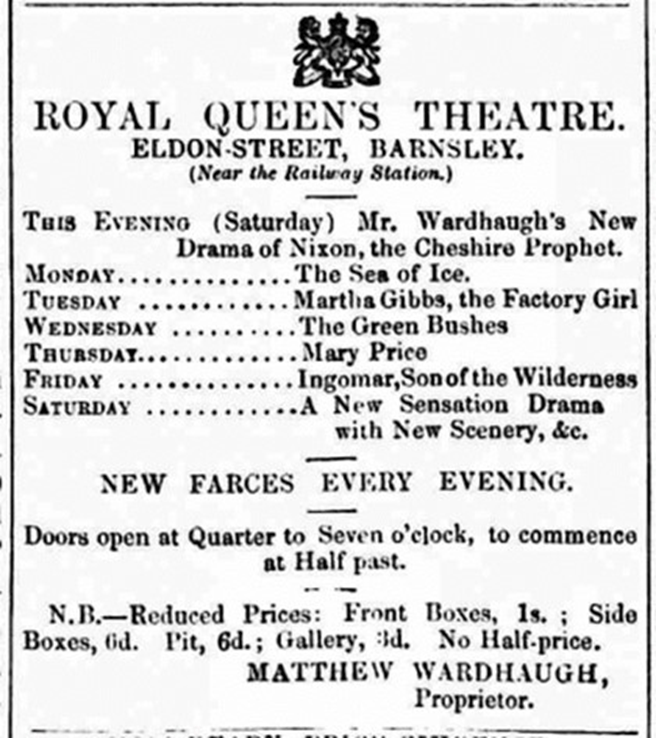
In 1870, the Barnsley Independent reported that a theatrical license had again been granted for the Queens Theatre in Barnsley in the name of Mr Wardhaugh. In the 1871 census, Matthew and Eliza are listed living at 85 Sheffield Road, Barnsley, with a 16 year old servant, Anne Willshaw. Anne’s birth place is recorded as Longton, Staffordshire, suggesting that the Wardhaughs had brought her with them to Barnsley. Matthew’s occupation is listed as a general theatre manager and dramatist, and Eliza’s occupation as actress.
This site has been associated with public entertainment since the early 1860s and is now home to Parkway Cinema, there’s more about the history of the building in our previous blog.
The Eldon Street High Street Heritage Action Zone Website
You can read lots more about the Eldon HSHAZ on the Barnsley Museums website, including an end of project video, we’ve even created a choose your own adventure YouTube game!



 Barnsley Museums Blogsite