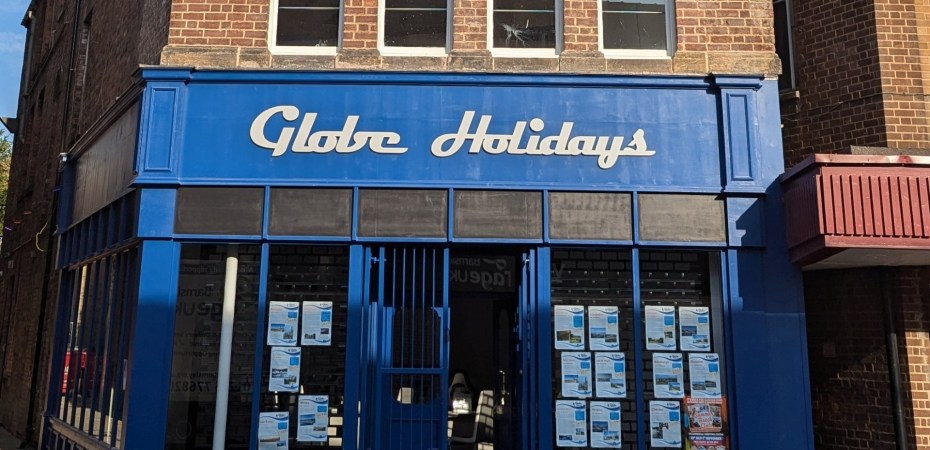
In this final part of the series of Eldon Street building blogs, we look at number 60 Eldon Street, which has been home to Globe Holidays since the late 1990s. Nestled between two larger buildings, it might be easily overlooked when walking by. When compared to other buildings on the street, it may not share the romantic histories associated with Harrals, The Civic or The Parkway, but this building has been home to a number of notable businesses over the years and has been fixture on the street since its construction started in 1875. It was also at the heart of a bitter fight between neighbours which split the local business community in the 1880s.
Recent renovation work supported as part of the Eldon Street High Street Heritage Action Zone (HSHAZ) has revealed architectural details that had been hidden for well over 100 years and have breathed new life into an otherwise tired-looking building. Archives and Local Studies sector specialist David Blunden and Dr Tegwen Roberts look back at the historical development of 60 Eldon Street and some of its previous occupants.
As described in our previous blogs, Eldon Street was first laid out in the 1840s as part of a deliberate expansion of the town centre beyond its medieval core. Development on Eldon Street itself was piecemeal, with many plots remaining open as gardens and unused space until the 1870s and 1880s. During this period a number of shops were built by individual developers, including 60 Eldon Street.
An uncertain start
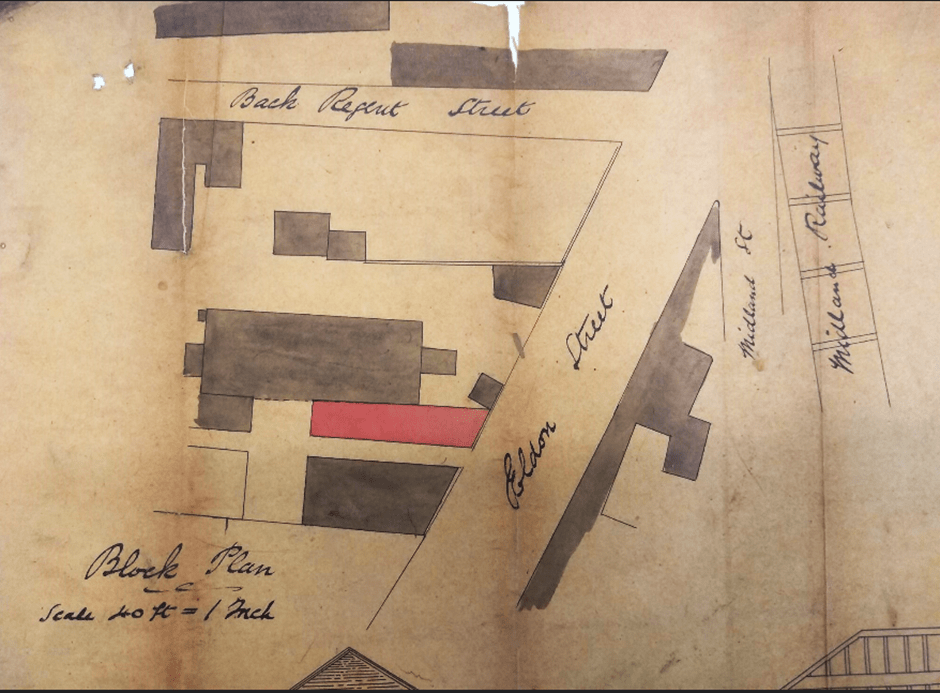
The story begins in early 1875 when architects Taylor & Senior of Barnsley submitted a ‘notice to build’ application to the borough council. Their client was Arthur Watson, an ironmonger, who was looking to move from his premises at 15 Market Hill (currently the Joseph Bramah pub) and build a three-storey shop in Eldon Street. This would be situated between the imposing five-storey warehouse of William Till (now Leslie Frances) and the wooden Royal Queen’s Theatre, which was set back from the road (now the site of the Parkway Cinema). At around the same time, advertisements inviting builders to tender for the works were published in the Barnsley Chronicle.
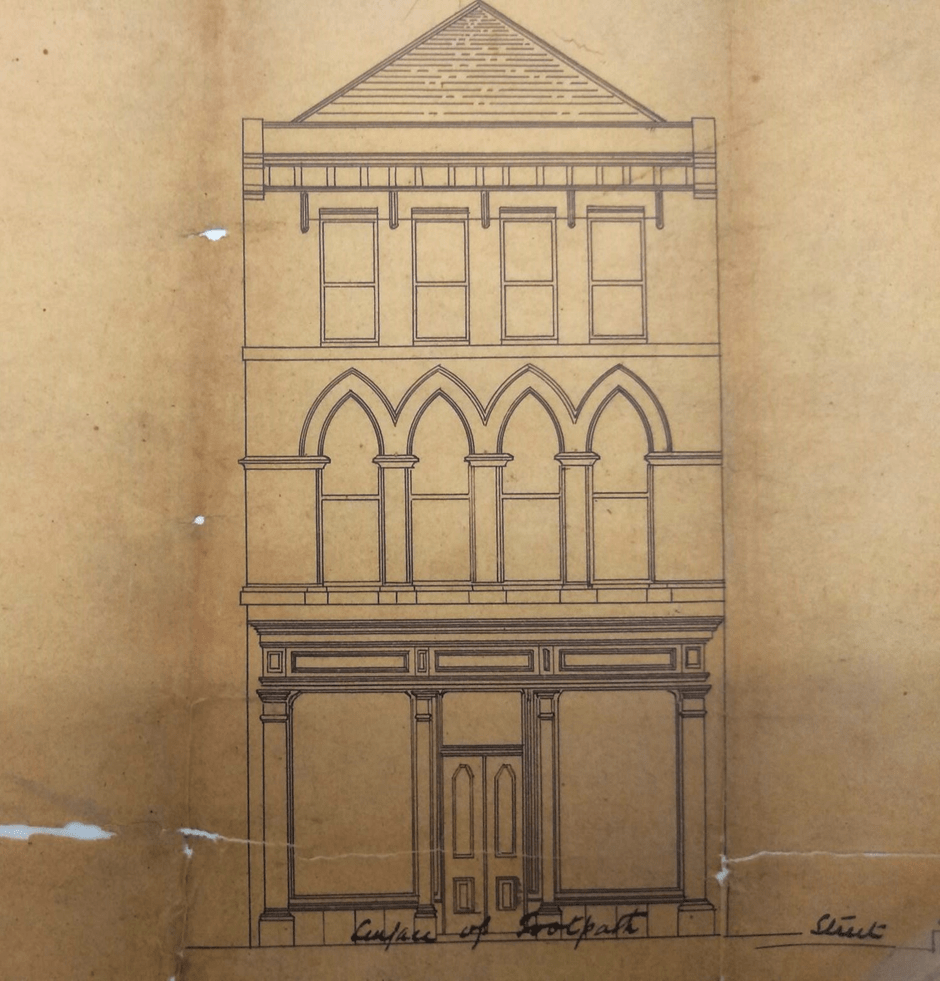
Later in the year during the month of July, the planning application for the design of the building was approved by the borough council. It shows a compact, symmetrical design, with a central door into the shop and tall windows with a decorative wooden shopfront and a narrow fascia with inset panels above. The upper floors of the building are instantly recognisable today from this drawing and it is only the ground floor detail that has been lost to modernisation over the years. Barnsley Archives and Local Studies holds the original building plans for this and many other buildings in Eldon Street. The plan for number 60 was carefully repaired in April 2024 by a conservator from West Yorkshire Archives Service as part of the High Street HAZ project and can be viewed in our searchroom during opening times.
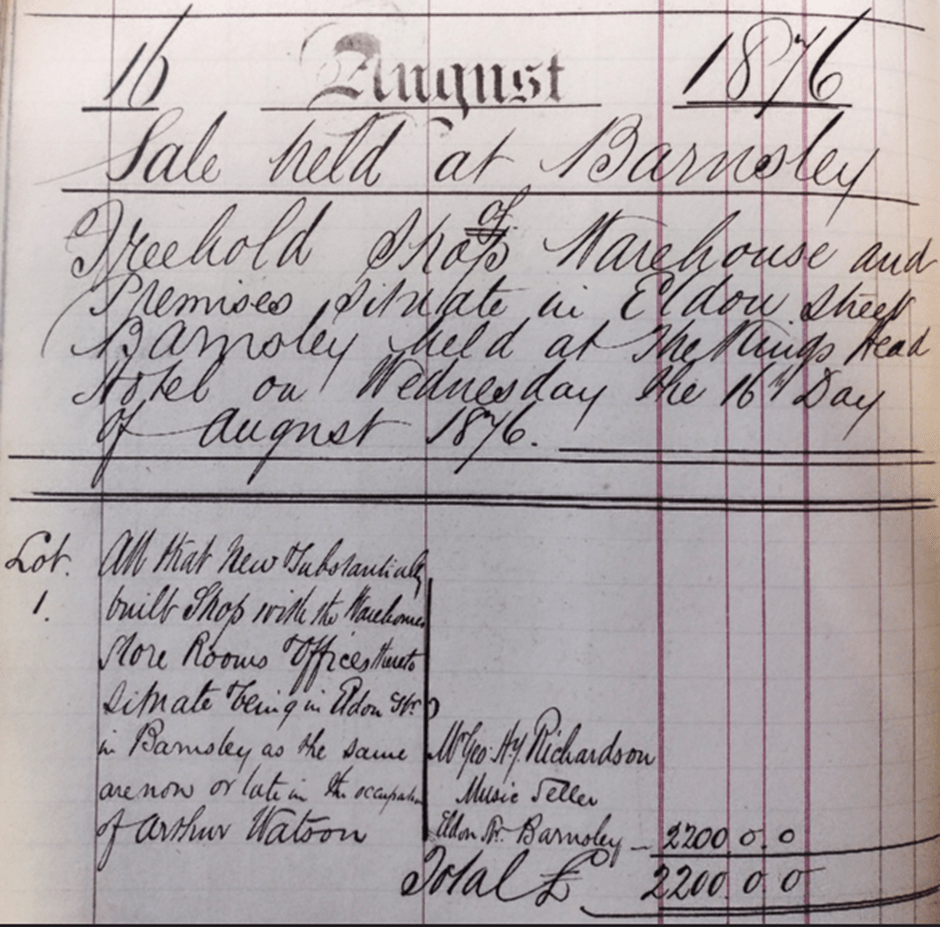
It is not clear at what date Arthur Watson’s new shop opened for business on Eldon Street, but we know from a newspaper article in the Barnsley Chronicle dated 19 February 1876 that G. Greenwood, a fabric and hat dealer, had already moved into Watson’s old shop in Market Hill during that month and was ready to open. However, all was not well at the new shop on Eldon Street. Only a few months after opening, an article appeared in the Barnsley Chronicle during May 1876 announcing an ‘important sale of ironmongery goods’ to be conducted by an auctioneer. It states that Arthur Watson has decided to give up the retail part of his business and continue wholesale only. We are not sure why this sudden turn of events happened, so soon after the building was constructed, but it is possible that there may have been a change in Arthur Watson’s personal circumstances. The retail business was wound down during the summer months and the next development was the sale of the building at auction on 16 August 1876. The building is described in the Barnsley Chronicle, dated 12 August, as having ‘lofty and convenient rooms and cellaring, and being situate in Eldon Street, one of the most improving streets in the town’. We are fortunate that the sale was conducted by Lancaster and Sons, whose archival papers are held by Barnsley Archives and Local Studies. We can see from the records that the building was sold for £2200.0.0 (pre-decimal currency, around £138,000 in today’s money) to George Henry Richardson, a music seller. Richardson was no stranger to Eldon Street, for he already had a shop a few doors down (where he also lived with his family), which later became part of Harral’s business and is described further in our previous blog on Harral’s Ring Shop.
Music for South Yorkshire
George H. Richardson quickly adapted the property to suit his needs. As the property was designed and sold as a shop and warehouse, it had no living space. A month after purchasing the building, Richardson submitted a plan (which was approved) to convert the rear of the building on each level into a living room and bedrooms, with a new partition wall and a set of stairs for the public area.
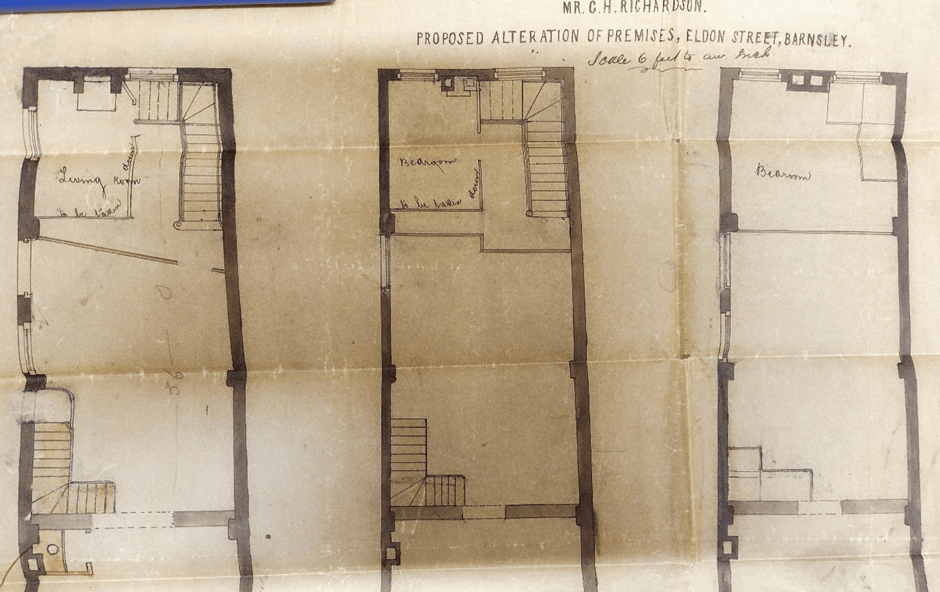
The shop was ready by November 1876 and was billed as the opening of the new ‘South Yorkshire Music Warehouse’ in the adverts placed in the Barnsley Chronicle during November and December. George Richardson sold a range instruments including pianofortes, harmoniums and American organs. He also employed a piano tuner and was a known supporter of The Harvey Institute/Public Hall (now Barnsley Civic), where he would organise events and sell tickets from his shop for certain performances. However, it wasn’t long before a disagreement flared up between Richardson and his new next-door neighbour in the wooden theatre. At the start of 1880 George H. Richardson brought up a series of complaints against the Queen’s Theatre, which had changed ownership and was rebuilt in 1876. These allegations formed the basis of an application for an injunction from the High Court of Justice. Mr Richardson had concerns about the construction of the theatre, which was constructed out of wood and covered with tarfelt, and about the noise from performances. A newspaper article of the time states that ‘Richardson was deprived of sleep, and kept in constant fear of being burnt to death in his bed’ (Barnsley Chronicle, 7 February 1880, p5). As has been illustrated earlier in the blog, the family’s living quarters were at the rear of the property, closest to the theatre, which explains this reaction. Needless to say, there was a lot of local support for keeping the theatre open and sympathy for the theatre owner Benjamin Walker, with counter arguments that there had been a theatre on the site for longer and that Mr Richardson had only relatively recently been given approval to live in the building. There was also feeling that, as Richardson was a promoter of the Public Hall, this may have contributed to his campaign against one of its competitors. A court case ensued, which was reported at great length in the local newspapers and involved testimonies from other local businesses and even the police in support of the theatre. Ultimately, however, the injunction was successful, and the theatre was sold and ordered for demolition. This story is covered in more detail in a previous blog on the history of the Parkway Cinema site.
The Richardson family continued to live in the property with the business taken over by George’s son Herbert by the time of the 1901 census (numbered as 42 Eldon Street at this time). He was living with his wife Betsy and children John and Mildred along with two servants, although the census records suggest that, by this time, it was becoming less common for families to live in the same building as their shops on Eldon Street. Trade directories of the time show that as well as the music business, Herbert was also trading as Barnsley & District Billposting Co. Ltd from the same building, where he was managing director. The family was last listed as living in the building in the 1904 electoral register. They had moved to Western Street in Barnsley by the following year. By this time the upper floors of the front of the building appear to have been covered with a heavy cement-based render for unknown reasons.
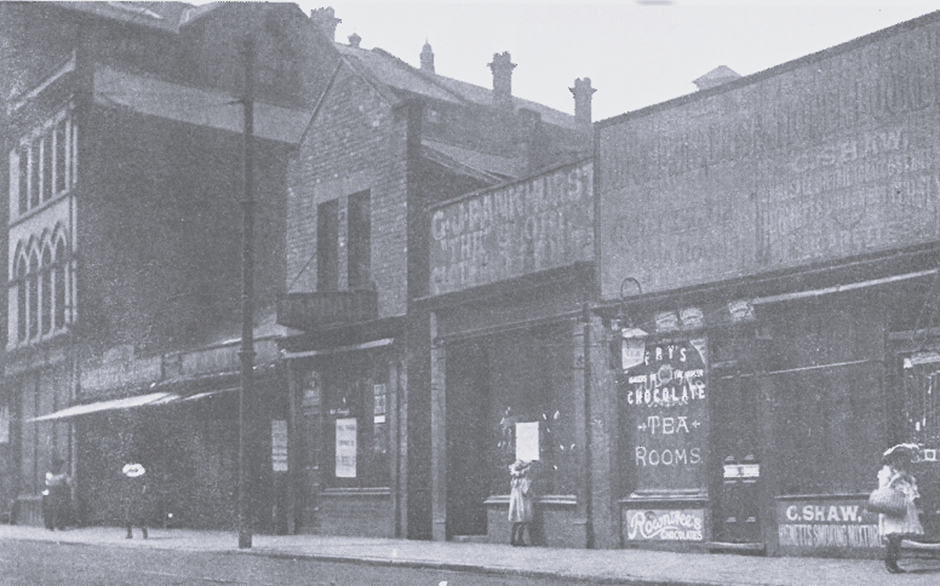
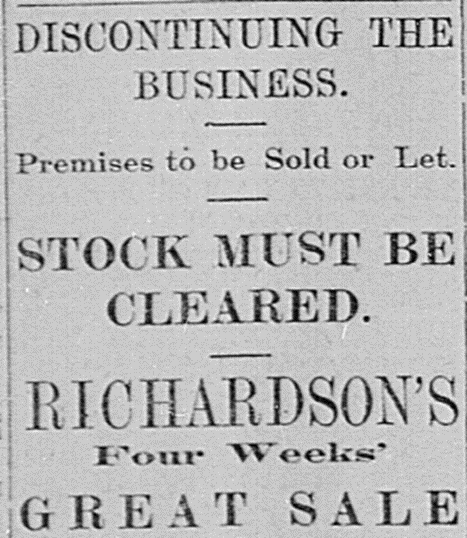
Despite no longer living in Eldon Street, Herbert Richardson continued to run the shop for the remainder of the decade. In February 1911 a notice appeared in the Barnsley Chronicle advertising a four-week closing down sale. The census taken in April of that year shows that Herbert Richardson was now working from home in Western Street.
Furnishing Barnsley
The next occupant of the Eldon Street building was Harry Roebuck who ran a chain of furniture shops, with branches already trading at Wakefield, Dewsbury and Morley. In October 1911 it appears that the shop was due to or had recently opened, as an advertisement had been placed in the Barnsley Chronicle by Harry Roebuck for a shop assistant. By this time the building had been renumbered to the current address of 60 Eldon Street.

Roebuck’s have to date been the longest occupiers of number 60. Their stay lasted until the late 1960s. During this time the shopfront was significantly altered, creating a much larger space for the shop sign and moving the door to the right of the shop.
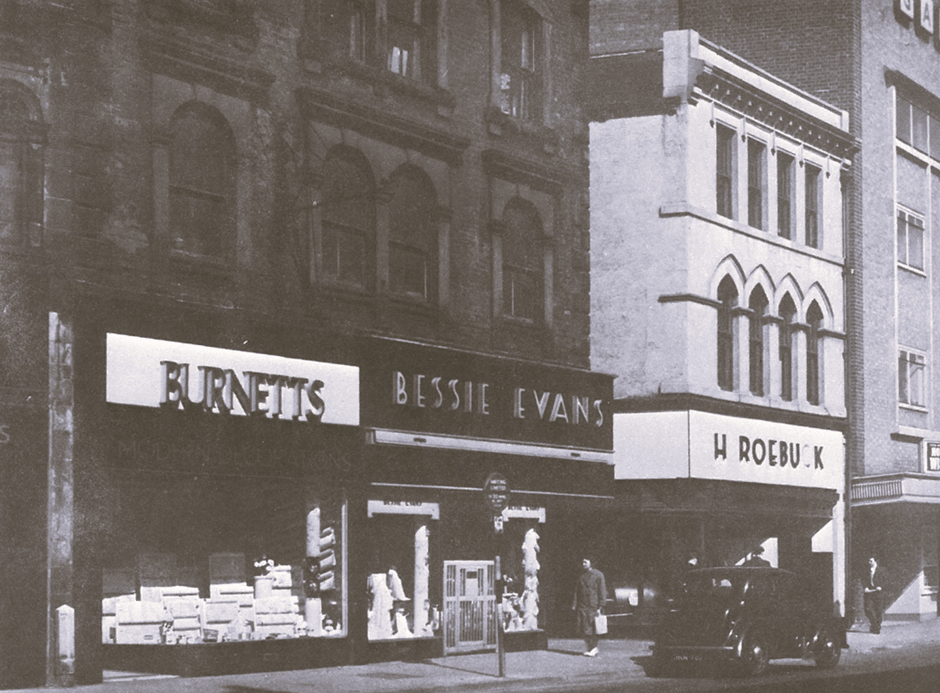
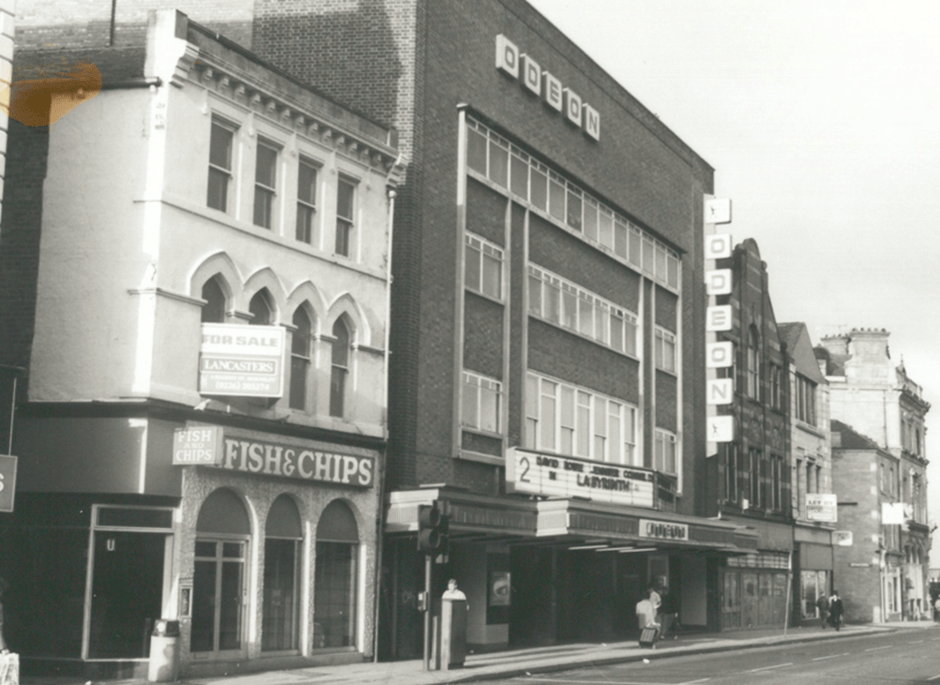
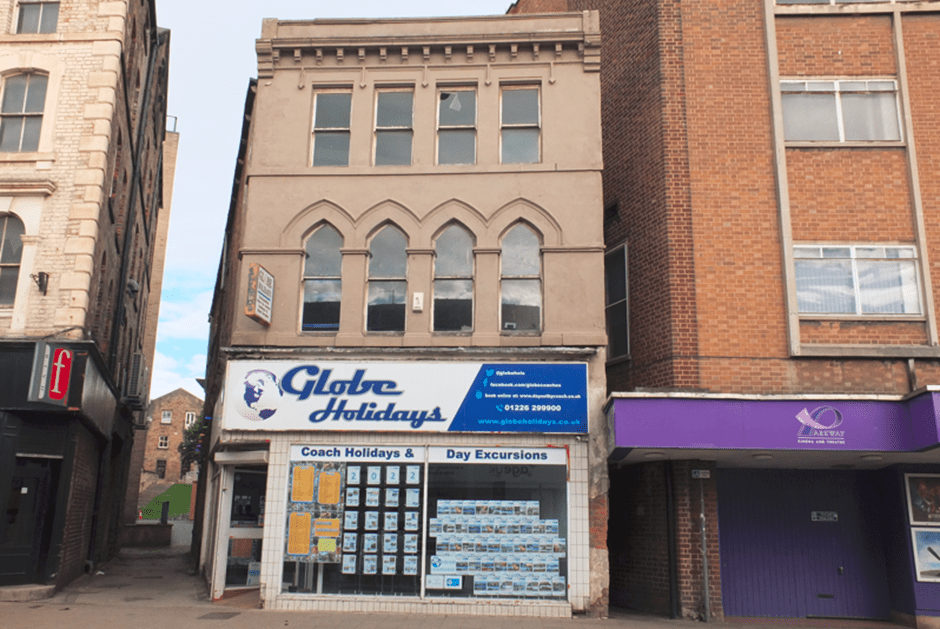
The property was then taken over by H. Freeda, another furniture business, in the late 1960s who stayed until the early 1970s. During their stay the shopfront was again altered, with the doors moving to the corner of the building. In 1971 a plan was submitted to change the building into a coffee lounge and steak house called Acropolis. This started a long period of the building being associated with serving food. At this point a new shopfront was again installed, which also moved the doors, this time to the left of the front elevation. At the same time new textured cladding was fitted to the shopfront to give the windows an arched appearance. The building retained this style throughout the 1970s and 1980s, during which time it became Nectar coffee lounge in the early 1980s, Taj Mahal restaurant early to mid-1980s and a fish and chip shop run by Perkins Cudworth from the mid-late 1980s. In the late 1980s a new shopfront was installed which removed the textured cladding and replaced it with white tiles. The building became another takeaway, this time for American Fried Chicken until the mid-1990s before a short spell as ‘Gringos’ restaurant. In 1999 the present occupiers, Globe Holidays, moved from the corner of Wellington Street/Lower Castlereagh Street into the building and this event was featured in the Barnsley Chronicle in the February of that year.
Renovation with the High Street HAZ Project
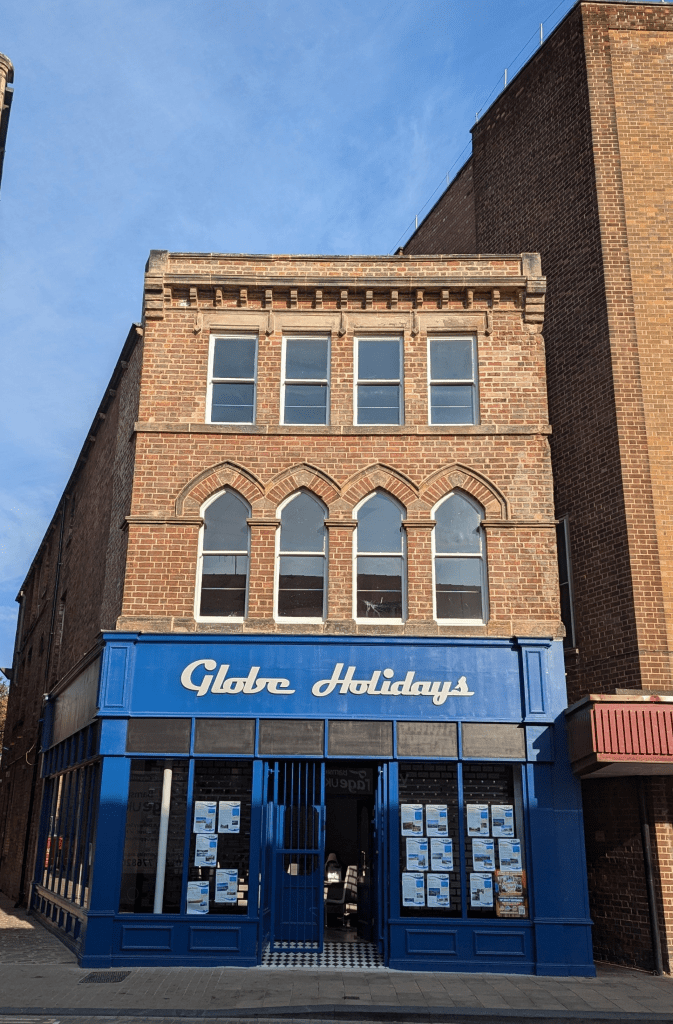
In 2023 the building received a grant from the HSHAZ project to support the complete renewal of the façade. This involved the removal of the cement render from the upper floors and the complete replacement of the late 1980s shopfront. The new appearance of the building has highlighted architectural details that no one had seen in living memory. These details include decorative stone lintels above the second floor windows and contrasting brick arches with keystones at first floor level above the gothic-style arched windows. The decorative stone parapet at the top of the building is again prominent against the brickwork. It was not possible to reinstate the original design of the shopfront due to structural alterations that were uncovered during the renovation. However, the new shopfront is in a traditional style and has been designed to enhance the proportions of the overall building. The refurbishment work was completed during summer 2024 and has been very positively received by users of Eldon Street and the customers of Globe Holidays who have called into the shop and followed the restoration with interest.
Sign up
Be amongst the first to receive future blogs direct to your inbox
Have you read our recent blogs?


 Barnsley Museums Blogsite