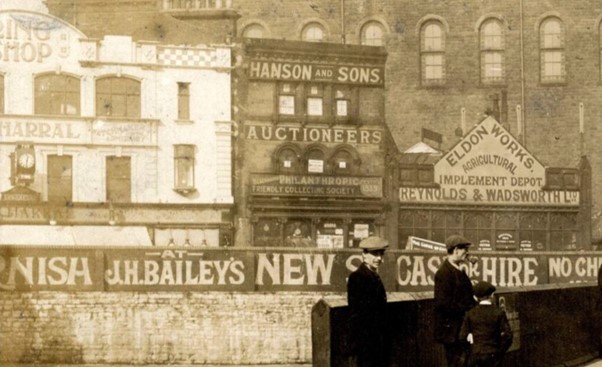
The iconic white buildings at 32-38 Eldon Street are landmarks in Barnsley Town Centre. The best-known is the former Benjamin Harral’s Ring Shop, with its distinctive frontage. Many generations of Barnsley residents bought their wedding and engagement rings from Benj Harral’s. However, the row has an earlier history which predates the arrival of the Ring Shop by at least 30 years. Community sector specialist David Blunden and Heritage Action Zone officer Dr Tegwen Roberts take a look through the historical development of 32-38 Eldon Street and some of its previous occupants.
As described in our previous blogs, Eldon Street was first laid out in the 1840s as part of a deliberate expansion of the town centre beyond its mediaeval core. Development on Eldon Street itself was piecemeal, with many plots remaining open as gardens and unused space until the 1870s and 1880s. During this period a number of shops were built by individual developers.
The earliest building (34 Eldon Street)
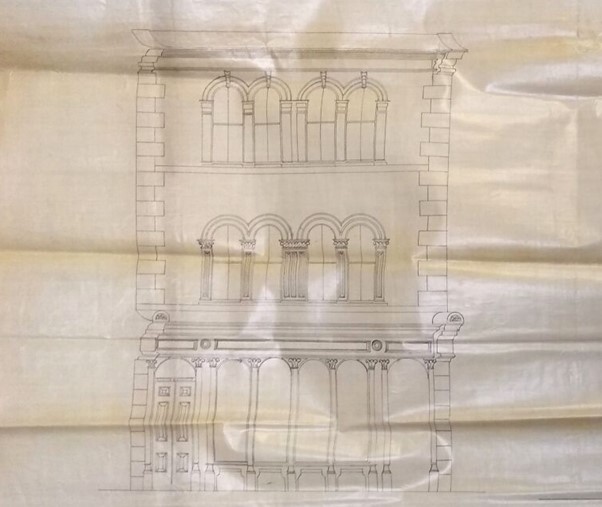
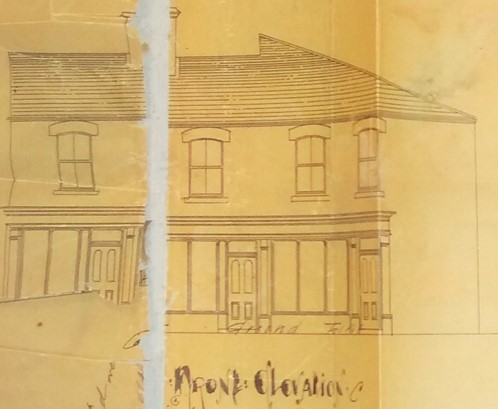
The first of the three buildings from the Harral’s block to appear on Eldon Street was the middle building, which is now number 34 (originally number 6 Eldon Street). The plan for the building was submitted to the local council in 1870 by John Ashworth. It appears that the first version was rejected during October of that year, before being passed in the December. Barnsley Archives has a version of the plan in its collections. On closer inspection the design has an extra set of windows compared to the three as built, so this may be the earlier plan.
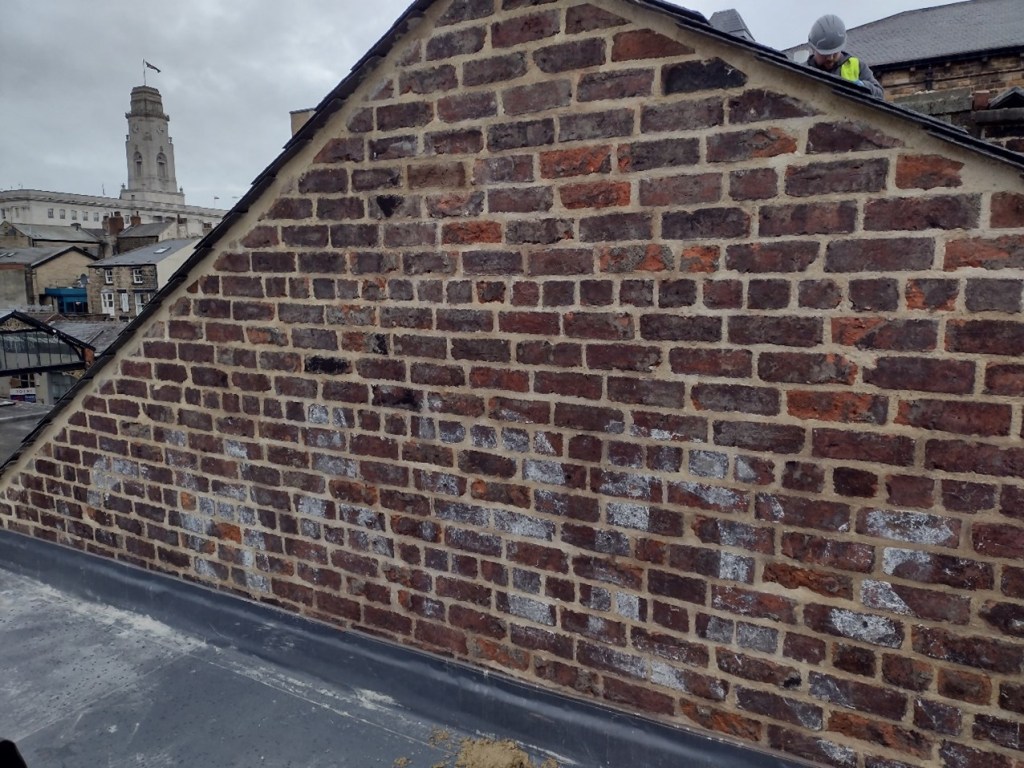
The first recorded business to operate out of the building was George Henry Richardson, who occupied the property in the early 1870s and ran a music shop, selling musical instruments and sheet music. An advert was published in the Barnsley Chronicle in June 1872 for the opening of Richardson’s ‘new pianoforte and harmonium rooms’ at number 6 Eldon Street. During the HSHAZ funded works in 2023, the remains of a heavily weathered painted sign advertising Richardson’s was uncovered at roof level, on a gable wall that would have been visible from Eldon Street but is now partly covered up by a later roof, and hidden by the Ring Shop frontage next door.
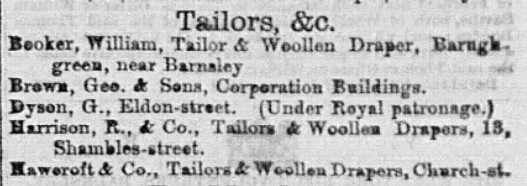
Richardson took up new premises on Eldon Street in 1876 and the shop was then occupied by tailor George Dyson. In 1879, George’s business is noted as being ‘under royal patronage’ in the trade directory section within the Barnsley Chronicle. We wonder whether royalty ever visited his shop?
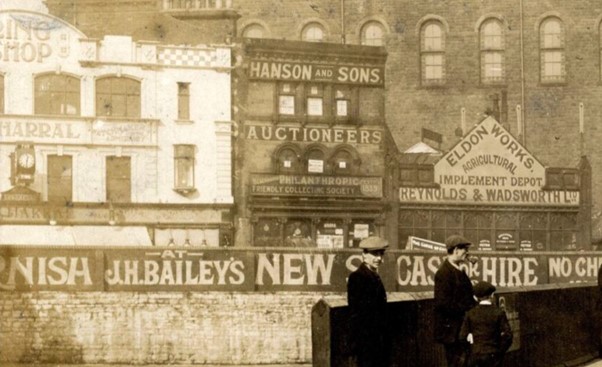
The next business at number 34 was Robert Sampson, hairdresser, who occupied the building during the 1880s and 1890s. The 1891 census shows Sampson, his wife Sarah and three sons also living in the building. The original building plans show the upper floors as bedrooms, with a living room behind the shop. Census records suggest this wasn’t entirely unusual on Eldon Street at this time. Following Sampson’s, and immediately prior to Harral’s, the property was home to Hanson and Son, estate agents, auctioneers and rent collectors. Early 20th century photographs show the building covered with bold signage advertising the company name and its services.
The second building (32 Eldon Street)
Although it is best known as Benj Harral’s ring shop, the beginning of 32 Eldon Street pre-dates Harral’s occupation by nearly 30 years. The original building plan was submitted in 1875 by G. Swallow and was originally three separate small shops. Tasker’s Barnsley Streets list the original occupants as T.B Hunter, Singer Sewing Machine Company and R.J. Tinker. The Singer Company became longstanding residents of Eldon Street as they later moved into one of the shops at the front of the Civic Hall and remained there for over 100 years
Benjamin Harral’s early years
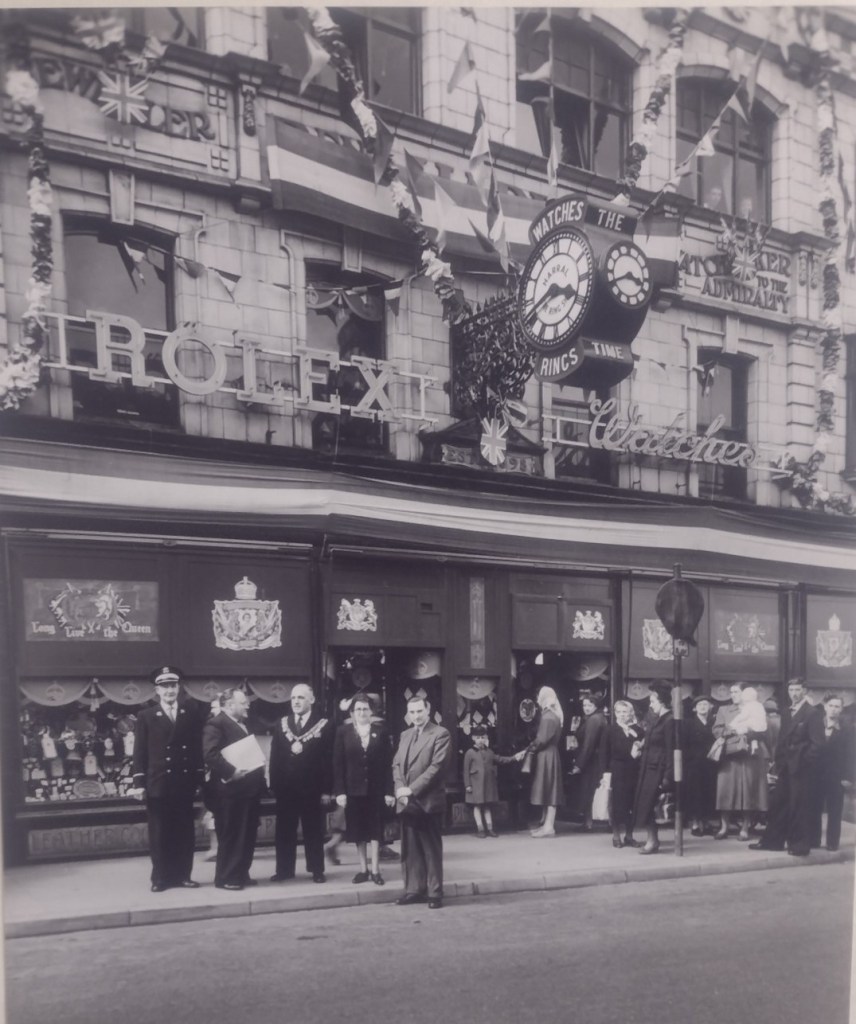
In 1904 the building became home to Benj Harral’s who relocated from another shop at the end of Eldon Street, where the old Yorkshire Penny Bank (now Paddy Power) is now. Benjamin was an apprentice watch maker, and made clocks, watches, jewellery and leather goods. He was a member of the Clock Makers Company, one of the ancient City Guilds, and was given the freedom of the City of London. He made watches for members of the Admiralty, for use in the Royal Navy.
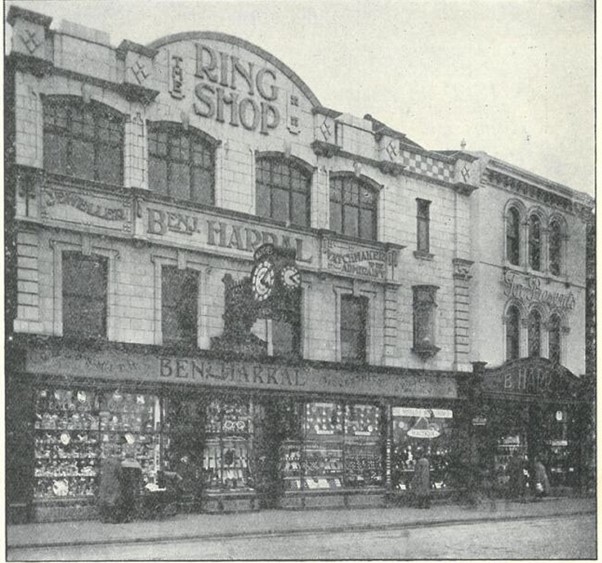
The ornate clock was installed shortly after they moved in, along with a decorative tiled shopfront that spanned all three of the original properties. Advertising was obviously an important consideration from the start, and photographs of the original shop at 32 show large painted sign boards along the roof line announcing ‘The Ring Shop’ and rings ‘my speciality’. The original tiled fascia sign survives (at least in part) underneath the current shopfront, and the top of the decorative door head can be seen above the later marble (this is discussed further in the Ghost Signs section below).
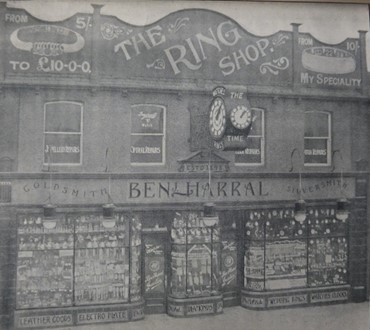
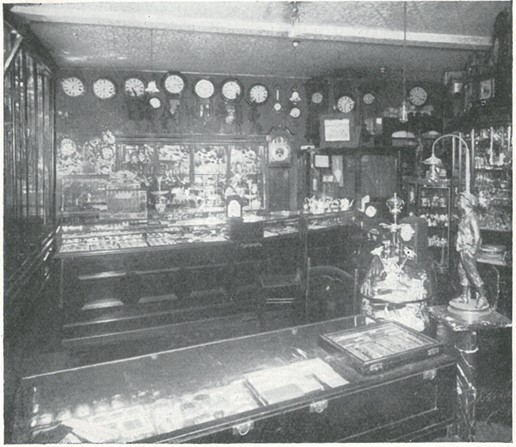
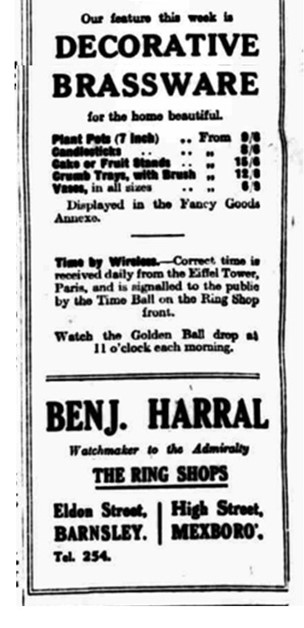
In 1913 Benjamin Harral undertook a further programme of refurbishment as he was finding the building too crowded for his growing business. He expanded upwards and built an additional floor, then decoratively reclad the building in white faience, to the design visible today. This included a large permanent ‘Ring Shop’ sign at high level, and further signage between the windows on the upper floors. The new frontage also included a tall, thin window on the first floor that was designed to house a golden Time Ball. This sort of timepiece, more usually associated with maritime cities, was connected wirelessly to the Eiffel Tower in Paris and the ball fell at 11am precisely each day, so clocks and watches could be set to the correct time. The Time Ball was included on the business’s advertising through the 1920s and was clearly a promotional show piece. We don’t know exactly when it was removed, but local memory suggests it was at some point in the late 1930s.
Expansion of the business
As trade continued to increase for Benj. Harral, the business decided to expand again and acquire the former shop of Hanson and Son at number 34. Harral’s had a large, curved shop sign installed above the ground floor entrance and with the words ‘for presents’ mounted on the brickwork at first floor level. This allowed the business to expand its clock making section along with selling jewellery, watches and leather and fancy goods.

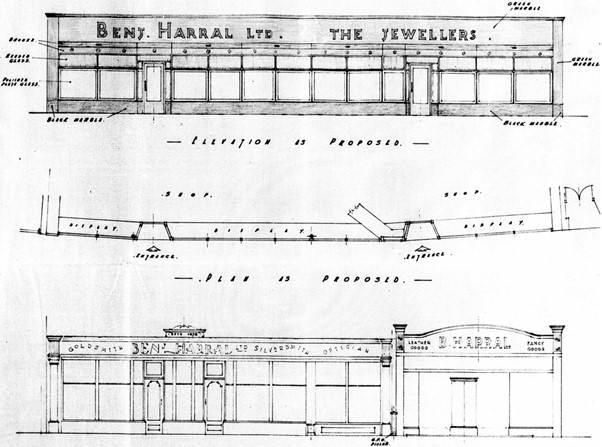
In 1954 Harral’s submitted a building plan to modernise their shopfront which harmonised the appearance of the two buildings. This design with a dark green marbled finish and dark window frames at ground level is what largely survives to the present day.
Third building (36-38 Eldon Street)
In 1925 Harral’s submitted a plan for a striking three storey building on a corner plot facing Eldon Street and the Arcade. This replaced an earlier single storey building which housed Reynolds and Wadworth’s agricultural implements depot. The façade to Eldon Street was of white faience tiles, similar to those used for 32 Eldon Street, with a pale-coloured brick on the Arcade side. This building was originally designed to have four shops (with entrances on both Eldon Street and the Arcade) and offices above. Harral’s used one of the shops (no. 39 The Arcade) with the other original businesses being TK Modes, milliners (no. 41 The Arcade), Jackson Ltd, outfitter (no. 43 The Arcade, on the corner of Eldon Street) and S. Tetley & Son, tobacconists (no. 36 Eldon Street).
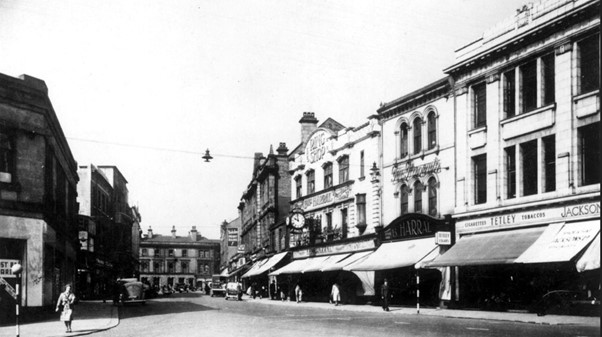
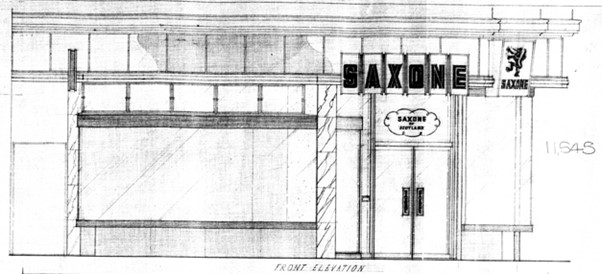
By the 1960s the majority of the ground floor was being used by Benj. Harral’s as they continued to expand their business. The very end of the row was rented to Saxone, (who had merged with the Cable Shoe Company – see ghost signs section below). Saxone occupied the corner of Eldon Street and the Arcade for over 30 years, before moving to Queen Street. The offices above were occupied by the Inland Revenue.
The end of an era
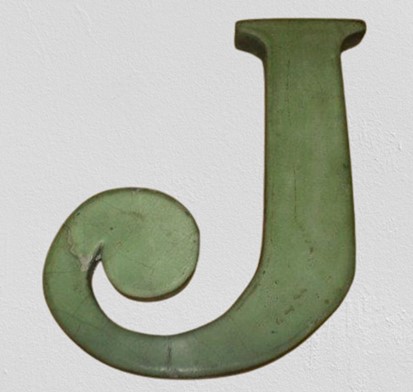
In January 1985 it was reported in the Barnsley Chronicle that Benj Harral’s shop was to close. After a period of standing empty, the familiar green lettering was removed (this sadly involved completely removing the front of the decorative tiles. Only one of the original letters is known to survive, and this is currently on display in Experience Barnsley) and the building was painted white, ready for the next occupants. Saxone also moved out at around the same time.
During the 1990s the buildings were occupied by businesses including Lancaster’s (estate agents), Barnsley Chronicle (newspaper offices), Brian Lindsay (household goods) and briefly, Whizz Kids, (computer games). In the 21st century former businesses have included Lime (recruitment), Prisco’s (curtains & fabrics), Wallace Arnold (travel) and Britannia coffee shop in the Arcade. Current tenants include His and Hers hairdressers (at 34) and Gee Vee travel (at 36-38).

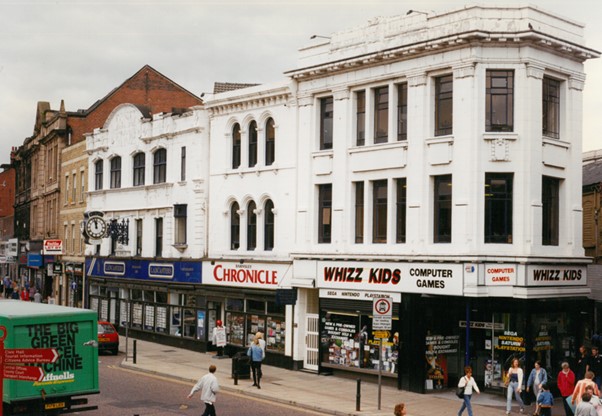
HSHAZ project work – a new beginning
In 2020 the Eldon Street High Street Heritage Action Zone identified the former Harral’s block as a high priority for conservation. By this time years of paint layers were peeling off, and the upper floors were semi-derelict with broken windows and water damage. The scheme worked with the building owners to put together a package of repair works, and work started on site in 2022. Unsurprisingly, as is often the case with historic buildings with complex histories, the project has thrown up a number of challenges, but as this blog is being written in February 2024 the scaffolding is finally coming down, with the upper-level conservation works complete and work to restore the historic shopfronts now underway. The historic clock will be removed shortly for careful renovation off-site, and will be returned to the building later in the year.
The place of the Ring Shop in Eldon Street lore
The Harral’s clock is a well-known and well-loved feature in Barnsley town centre. Before the days of mobile phones, it was a popular meeting place for friends and couples (along with the ‘Three Penny Bit’ in the bus station). This status as a local landmark was celebrated in the Ballad of Eldon Street folk ballad that was aired on BBC Radio 4 in September 2023 and is still available on BBC Sounds. Listen to the Ballad of Eldon Street.
The Benj Harral’s shop was known for their elaborate window displays, which were a draw for visitors right up until the 1980s. In the early years they offered tours of their workshops on the first floor of the buildings and, along with other prominent businesses in the town centre, took part in civic events. Harral’s were particularly known for giving a personalised gift with every set of wedding rings purchased; usually an engraved bread knife or cake slice. This story was immortalised in ‘The Proposal’ by poet laureate Simon Armitage and his band LYR on their album ‘An Unnatural History’ which is available to listen and download from Bandcamp and Spotify. Listen to An Unnatural History on bandcamp.
Ghost signs
During the renovation works a number of fragile, historic ghost signs were uncovered, including the one for Richardson’s, and an unexpected sign for ‘Cable’ at 36 Eldon Street, on the corner of the arcade. Cable Shoes opened around 1950 and the brand was owned by Saxone. We hadn’t been aware of the Cable brand being used on the Barnsley shop until the sign was uncovered. It is likely that the Cable brand was used until it was replaced by the new Saxone sign and branding in 1959. Still long enough for it to leave a trace on the building. The older Tetley’s tobacco and cigarettes signage was also still visible next to the Cable shoes sign.
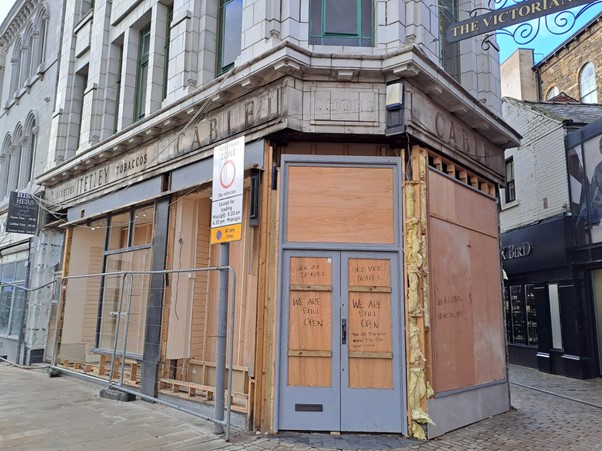
As mentioned above, part of the 1904 tiled shop sign also survives at 32 Eldon Street at ground floor level, although there appears to have been some damage to the tiles above and below it most likely caused when the 1950s shop front was installed. As part of the conservation works it was decided to leave this in situ, but to keep it hidden, as exposing it would involve removing part of the 1950s bronze and marble shopfront, which in itself has historic value. The decorative door head, is visible above the marble fascia below the clock. This has been carefully cleaned, revealing its original colours and the original wording ‘established 1898’.
Find out more
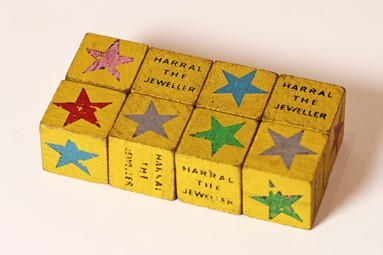
Barnsley Museums and Archives have collected some items from the Harral’s building over the years, including a bread knife, rings and even a promotional dice game thought to date from the 1950s. Sadly we don’t have a copy of the rules, so we would love to hear from anybody who remembers how the game was played! We also have in the collection one of the letters from the former signage above the shop, which is currently on display on Experience Barnsley Museum. A selection of some of the written records from Benj. Harral’s shop, including jewellery stock books and pawnbroking records can also be consulted in Barnsley Archives. Search the Barnsley Archives catalogue.
Did you know? After leaving 34 Eldon Street, George Henry Richardson continued to have a long, but not always smooth, relationship with Eldon Street. You can read more about this, and the controversial court case he brought against one of Eldon Street’s early theatres, in our recent Empire Palace of Varieties blog.
Have you read our other recent blogs?
 Barnsley Museums Blogsite
You must be logged in to post a comment.