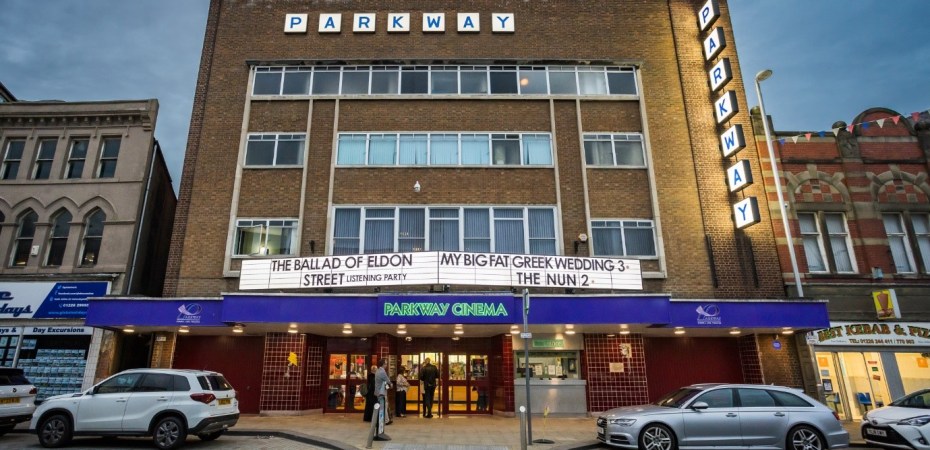
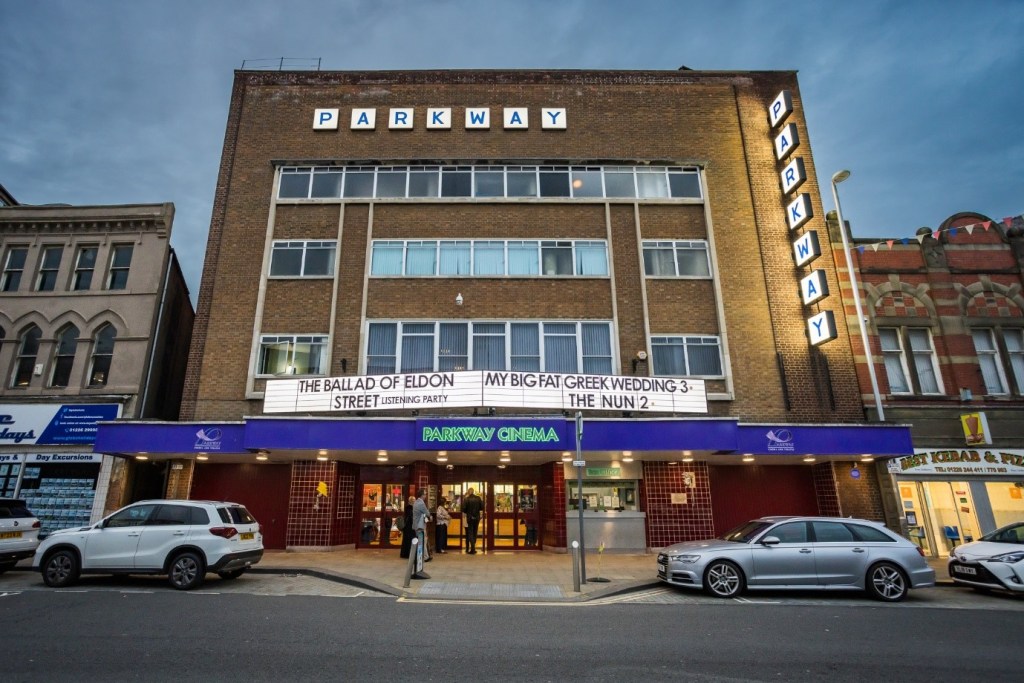
As part of a series of blogs on the history of buildings on Eldon Street in Barnsley Town Centre, Dr Tegwen Roberts (HSHAZ project officer) and David Blunden (Community Sector Specialist) take a look at the history of 62 Eldon Street, currently home to the Parkway Cinema. Now a popular independent cinema, 62 Eldon Street has a fascinating past connected to the early years of theatre in Barnsley. It has also helped us uncover a previously unknown part of Eldon Street’s story as an edge-land where, in the 1860s and 1870s, small-scale independent entertainment venues were able to temporarily establish themselves and thrive.
Early History of 62 Eldon Street
Eldon Street was first laid out in 1840, as part of a planned expansion of Barnsley town centre by the Barnsley Corporation. By this time the medieval core of the town had become busy and over-crowded and the new streets were designed to be wide and spacious (read more about the development of Eldon Street in our first Eldon Street blog).
The first edition Ordnance Survey map in 1850 suggests that the development of properties along Eldon Street was piecemeal to begin with, with many of the current building plots remaining as gardens and open space for a number of years after the street was established. Development accelerated after the opening of a new railway station on Eldon Street in 1850, however despite becoming a gateway to the town, Eldon Street was still on the edge of the established town centre and during the 1860s and 1870s there was still plenty of open space. This offered opportunities for creative uses. Although not shown on either of the first two large-scale Ordnance Survey town maps (published in 1852 and 1889) research undertaken as part of the Eldon Street High Street Heritage Action Zone (HSHAZ) has found that there were at least three wooden venues established along the street during this period connected with travelling entertainers, including circus performers and variety shows. Two of these were built on what is now 62 Eldon Street.
Royal Queens Theatre
The Royal Queens Theatre opened under proprietor Matthew Wardhaugh in December 1862. An advert was placed in the Barnsley Chronicle on November 19, 1862 to announce the opening.
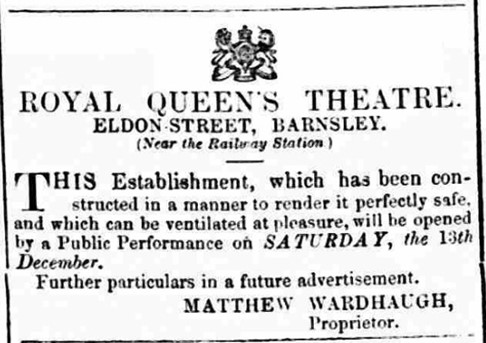
This immediate reassurance of safety in the opening advert is a clue to the fact that the venue was not of standard brick and stone construction. By the time the Royal Queens Theatre was opened Matthew Wardhaugh was an established theatre proprietor in the north of England. The obituaries printed after his death in 1888 stated that Matthew started his working life as a call-boy at Drury Lane theatre in London. He later travelled England and Scotland performing out of a van, which served as a travelling theatre. He established a more permanent wooden theatre in Longton in 1854, and with his wife Eliza went on to establish three other wooden theatres in Bury, Barnsley, and Leigh in Lancashire. He eventually settled in Longton, and served as alderman and mayor of the town in the early 1880s.
In Barnsley, the opening advert suggests that the public might be expected to view a wooden theatre with a degree of suspicion, particularly from a safety point of view. However, the Royal Queens Theatre apparently thrived, continuing to advertise shows in the local papers throughout the late 1860s and early 1870s. The shows were a mix of drama, farce and comedy, featuring both Matthew and Eliza Wardhaugh with visiting guest variety acts (such as Henry Smith and his Gigantic Diorama of America in 1863). Newspaper adverts listed different shows every night, including Christmas Eve and Boxing Day (in 1862). Although no plans of the theatre survive, the adverts give ticket prices for private boxes, side boxes, pit and gallery.
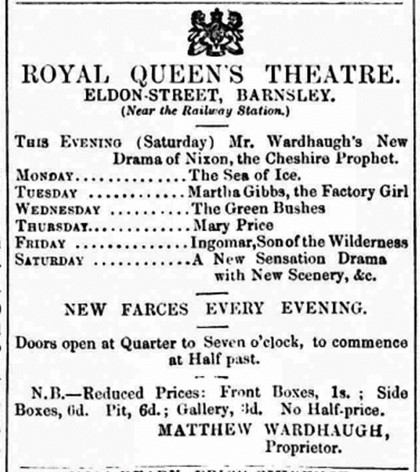
In 1870, the Barnsley Independent reported that a theatrical license had again been granted for the Queens Theatre in Barnsley in the name of Mr Wardhaugh. In the 1871 census, Matthew and Eliza are listed living at 85 Sheffield Road, Barnsley, with a 16 year old servant, Anne Willshaw. Anne’s birth place is recorded as Longton, Staffordshire, suggesting that the Wardhaughs had brought her with them to Barnsley. Matthew’s occupation is listed as a general theatre manager and dramatist, and Eliza’s occupation as actress.
Gaiety Theatre
In 1876 a planning application was submitted to Barnsley Corporation for a new wooden theatre on Eldon Street by Moxon and Son architects, for Messrs Walker and Jackson, on the site of the Royal Queens Theatre.
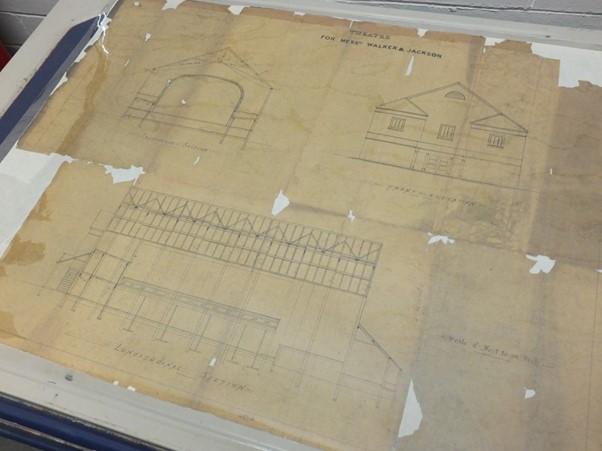
Ben Walker was a music-hall proprietor. After his death in 1910, an article in the Barnsley Chronicle reported that he came to Barnsley from Liverpool and took on the Charles Adams Circus (another wooden building on Eldon Street) on the site of the Public Hall, now the Barnsley Civic. The circus was built in 1874 and demolished when work started on the Public Hall in 1877. After the circus was demolished Mr Walker transferred his music hall to the former Queens Theatre, known locally as the ‘Old Match Box’ which he rebuilt as the Gaiety Theatre.
The plans that survive in Barnsley Archives were conserved as part of the Eldon Street HSHAZ, and show a substantial wooden building with ladies and gentlemen’s dressing rooms (each with their own toilet) and an upper circle with 5 boxes. It was lit by gas lamps. The theatre was set back from Eldon Street, with an external toilet block adjacent to the street. Again, the Gaiety Theatre advertised in the local papers, and hosted a wide range of music hall and variety acts.
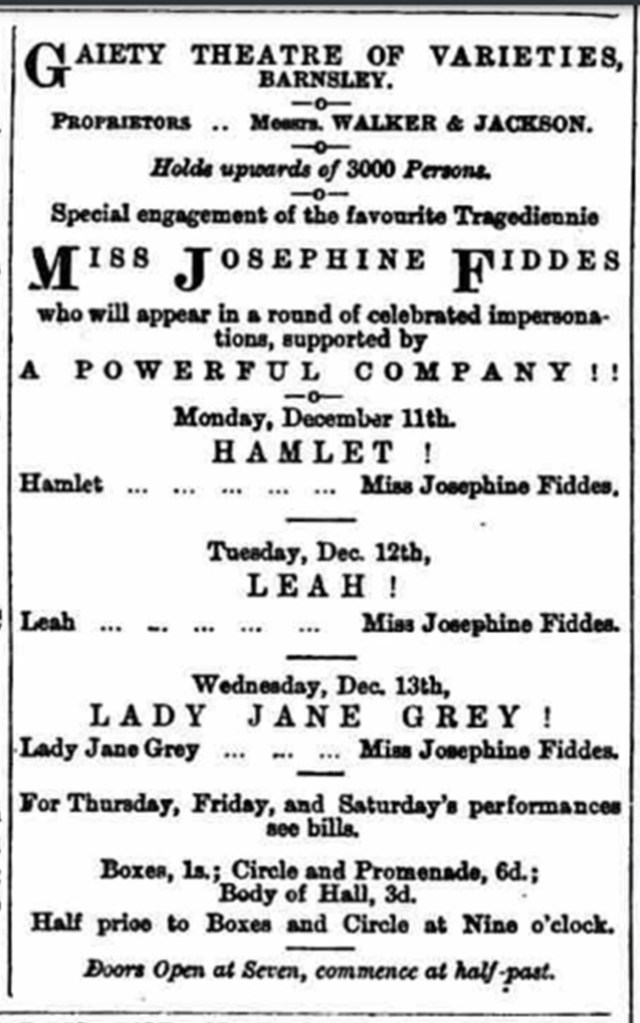
However, there was trouble brewing for the theatre. At the start of 1880, their neighbour Mr Richardson, who ran a music shop at 60 Eldon Street (now Globe Holidays) brought a series of complaints against them. The newspapers at the time reported that Mr Richardson had submitted an injunction to the High Court requesting they ‘prevent the theatre from continuing performances which, from their noisy character, were alleged to be a nuisance to the plaintiff’ (Barnsley Chronicle, February 21, 1880). The article also reported that Mr Richardson had asked the court to prevent the owner of the theatre allowing people to smoke on the premises, as he was unable to insure his property for less than five times the usual rate because of the fire risk.
Shortly after Mr Richardson submitted his complaints, a public meeting was held at the Market Inn in Barnsley, led by Samuel Pitt and John Frith, secretary of the South Yorkshire Miners Association. The aim of the meeting was to co-ordinate support for the theatre and petition against Mr Richardson. The Barnsley Chronicle (3 January 1880) reported that there was a lot of local sympathy for Mr Walker, not least because the theatre was established on the site before Mr Richardson moved into his property, and that Mr Richardson had only recently been given permission to live there. The theatre was also popular locally, and felt to be an asset to the town. The campaign was ultimately unsuccessful, and after a drawn-out court case, which was reported at length in the local papers, the theatre was ordered to close. An inspector from Barnsley Police gave evidence in court and spoke in defence of the Gaiety. He said that in his opinion the theatre was well run, and ‘a great benefit to the working classes’ with ‘sufficient provision against fire’ (Barnsley Chronicle, 24 April 1880). He also said that he considered ‘the class of audience and their behaviour in the present theatre much more orderly and respectable than in the previous one occupied by Mr Wardhaugh.’
In May 1880, the theatre was advertised for sale on the condition that it was knocked down within 14 days of the sale. The Barnsley Chronicle reported that ‘after a not very spirited competition’ the lot was sold for £47 and 11 shillings. The article went on to say ‘this is probably the last we shall hear of an edifice that has recently been the preducing cause of such an immense stir in […] the High Court of Justice, and which has unbottled so much prime forensic eloquence.’ (Barnsley Chronicle, May 22, 1880). In August the same year Benjamin Walker filed for liquidation.
Empire Palace of Varieties
In the early 1900s, a new theatre was established on the site of the Queens and the Gaiety, this time built of brick and stone. The Empire Palace of Varieties opened in 1908. It was designed by architects North and Robins as a ‘first class modern Music Hall’. A public shares drive was launched by a new company, the Barnsley Empire Palace Limited, in April 1908, with 12000 (out of 18000) ordinary shares offered at £1 each. The new theatre had seats for 2000 people with a gallery and 12 purpose-built dressing rooms. It also had an electric sliding roof. A row of new shops was created on the ground floor, fronting Eldon Street. One of the new tenants was Elizabeth Smith’s Umbrella Shop, which you can read more about in our Women Business Owners of Eldon Street blog.
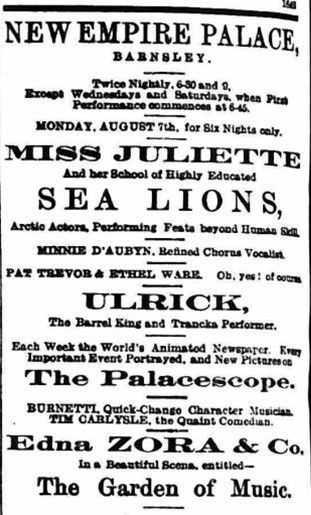
Again, in its early years the Empire Palace of Varieties hosted a wide range of music hall and variety acts, including Miss Juliette and her school of highly trained sea lions ‘performing feats beyond human skill’ in 1911. Moving images and early cinematic animations shown on machines like the Palacescope, also featured in the shows, often showing news from around the World.
A new era of cinema
Moving pictures became an increasingly popular part of the variety shows at the Empire throughout the 1910s, and in 1920 the theatre was converted to a full-time cinema. The Empire Super Cinema opened in March 1920. Sound was installed in 1929 and the first talking picture was shown in November of that year.
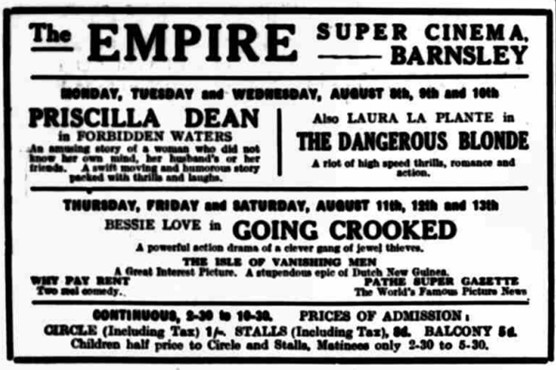
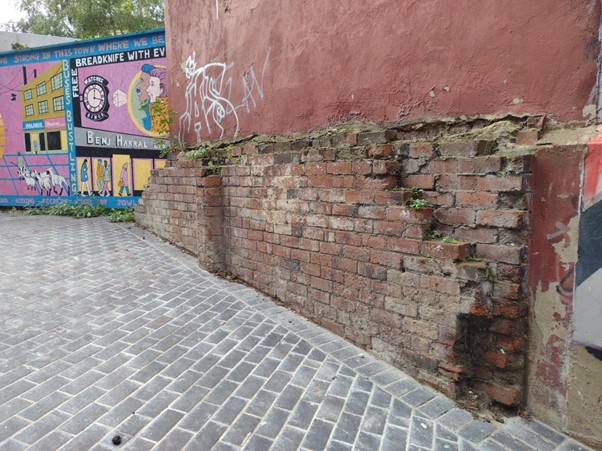
The cinema was renamed the Gaumont Cinema in 1950. In 1954 the building was destroyed by fire. The only remaining physical trace of the original Empire is part of a wall visible in the alley to the side of the present building. This was uncovered during improvement works in the alley funded as part of the Eldon Street High Street Heritage Action Zone in 2023.
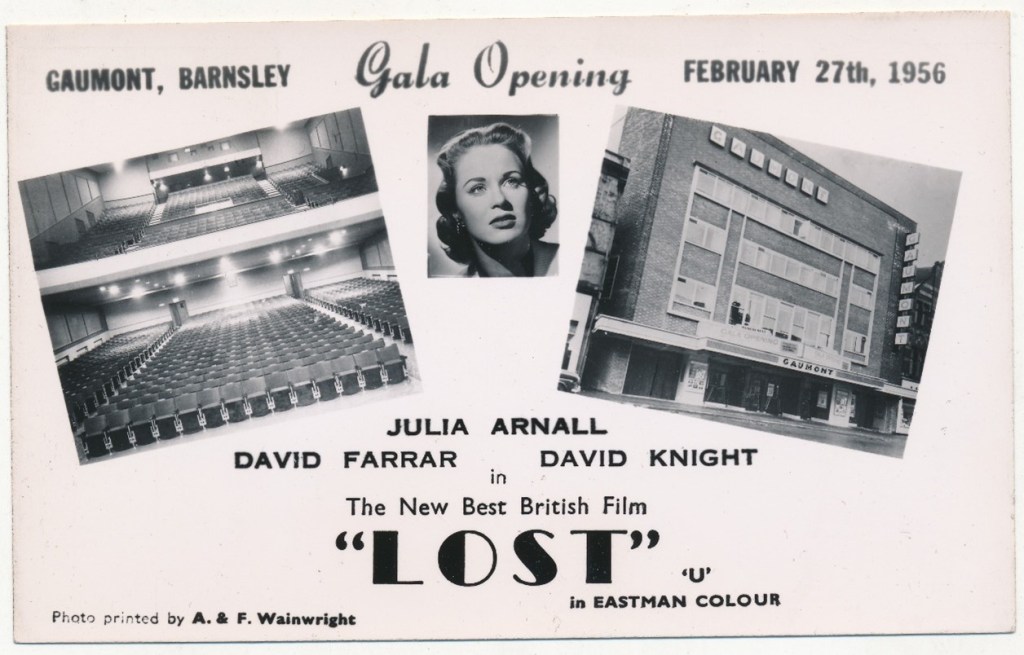
The cinema was rebuilt in a modernist style and reopened as the new Gaumont in 1956. The opening night featured the film ‘Lost’ with Julia Arnall, David Farrar and David Knight.
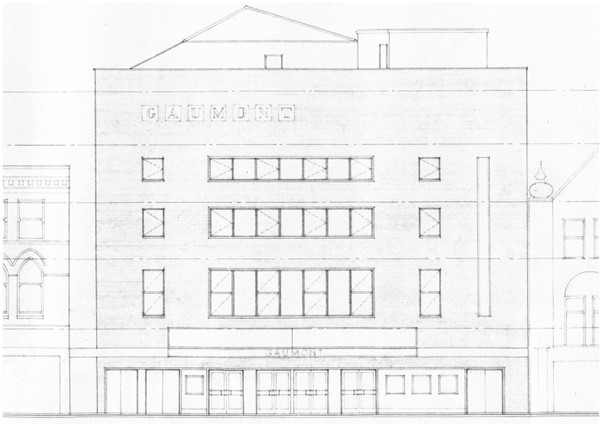
The cinema was renamed the Odeon in 1962. It closed in 2005, and reopened as the Parkway independent cinema on 8 August 2007, continuing nearly 100 years of film and cinema shows on the site.
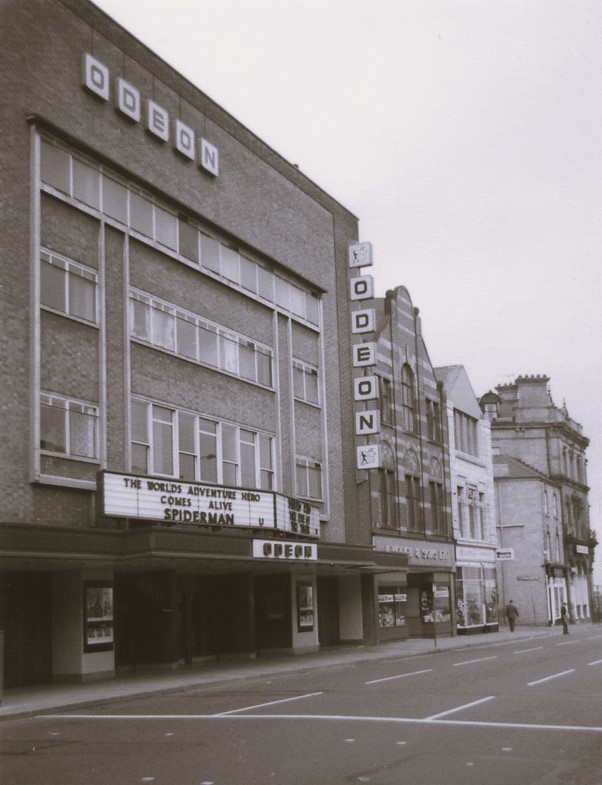
The Parkway continues to be a hugely popular independent cinema, and prides itself on preserving the art of projection, showing 35mm and 70mm film alongside digital films. It also hosts gigs and other cultural events, somehow reflecting the deep and ongoing connection of this site with independent variety shows and public entertainment. In September 2022 the Parkway hosted a special gig by poet laureate Simon Armitage and his band LYR inspired by the stories of Eldon Street. This in turn inspired a new radio ballad ‘The Ballad of Eldon Street’ which was aired on BBC Radio 4 in September 2023 and is still available to listen again on BBC Sounds.
The outside of the cinema building has been renovated (in 2023) with support from the Eldon Street HSHAZ. The 1950s style signage and red entrance tiles have been restored and the distinctive cinema read-o-graph reinstated. Over the next few months the canopy will also be restored, bringing the cinema building back to its former glory.
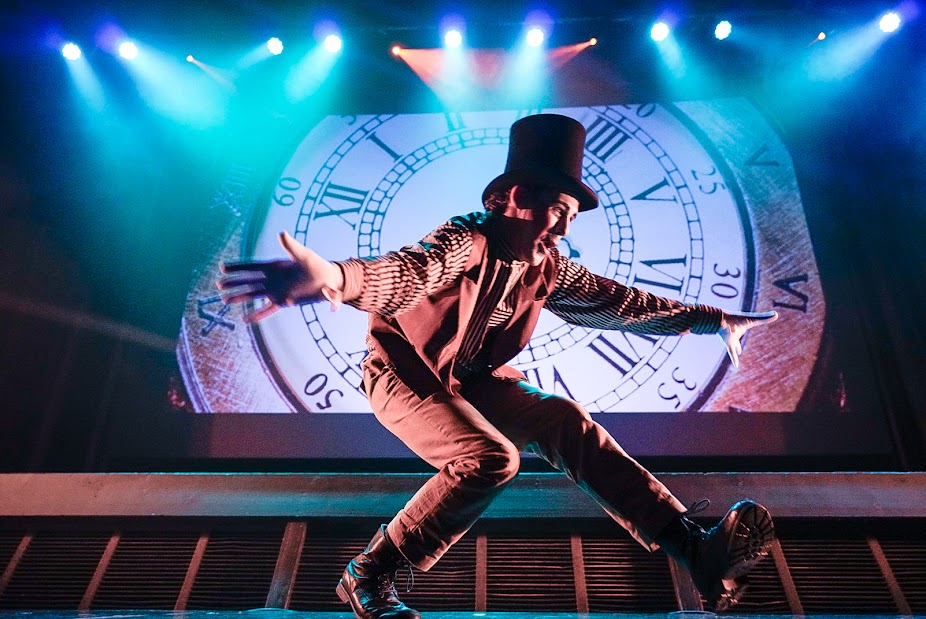
Empire Palace of Varieties celebrated with exciting new dance performance
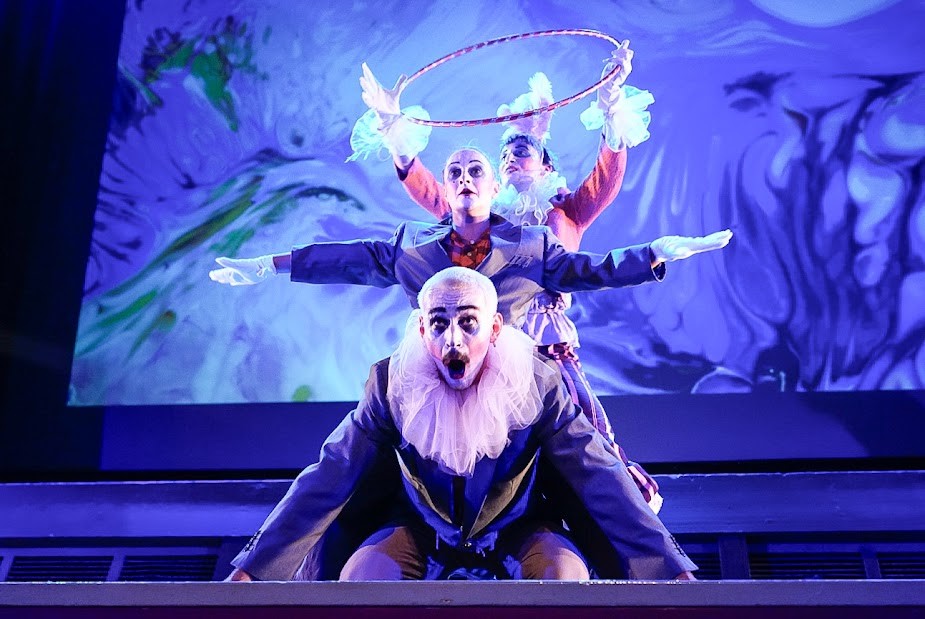
Gary Clarke Company, led by Barnsley born choreographer Gary Clarke, have used the amazing stories of 62 Eldon Street as the inspiration for an exciting new performance piece ‘Empire Palace of Varieties’. This was funded by the South Yorkshire Combined Mayoral Authority as part of the Shared Prosperity funding, and was premiered at the Parkway Cinema over two days in September 2023. The performance explored the different threads of the site’s story – including Benjamin Walker’s fight to save his theatre, Miss Juliette’s performing sealions and the Empire Theatre fire – through movement and dance, with a bespoke soundtrack and film backdrop. The response to the performance was incredible and at times very emotional. An amazing way to celebrate this hugely important but previously unknown piece of Barnsley’s history.
For more information about events at the Parkway (and to book tickets) visit the Parkway Cinema website. For more information about the Gary Clarke Company and their acclaimed Wastelands tour visit the Gary Clarke Company website.
With thanks to Mark Farnsworth for sharing information about his ancestor Benjamin Walker, and for first drawing our attention to his Eldon Street story. Do you have an Eldon Street ancestor? We'd love to hear about them!



 Barnsley Museums Blogsite