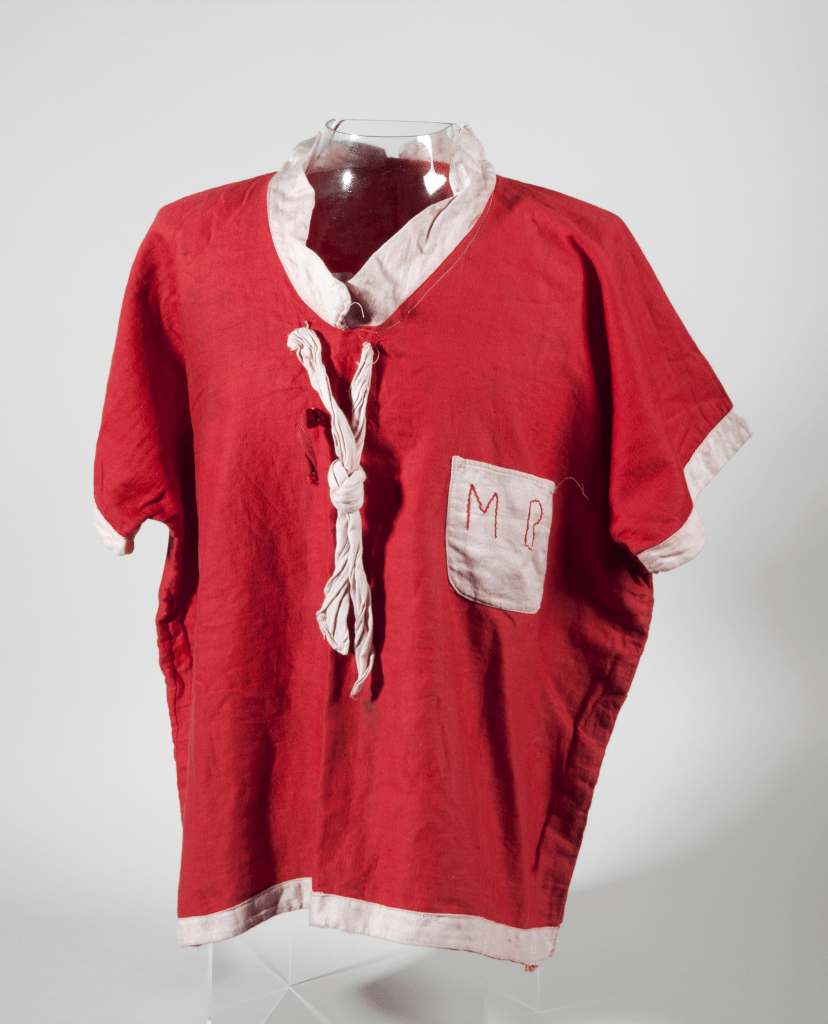
Every one of the objects in Experience Barnsley Museum has a story to tell. One of our front of house team, Amanda Stoner, tells us the fascinating story behind just one of them – her grandma Frieda’s football shirt. Dating from 1926 the shirt has a lot to tell us about Barnsley at the time.
In September of 1939 the Barnsley Chronicle ran the obituary of Joseph Henry Dodd….
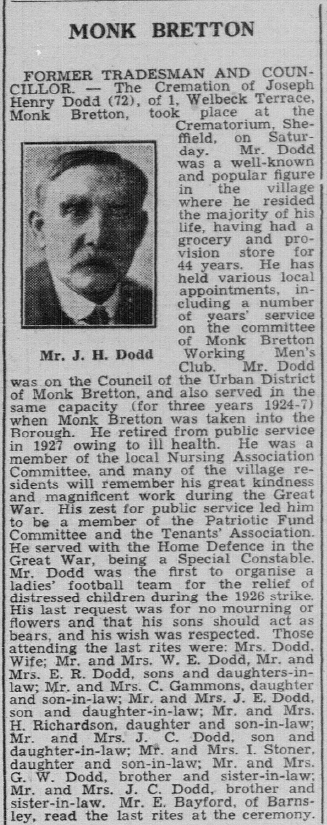
It mentions all the usual things that an obituary would like his long service as a councillor and his popularity in the village of Monk Bretton where he ran a grocery and provisions shop for 44 years. It’s a pretty standard memorial to the life of a well-regarded, civic minded gentleman of the era. But there is a sentence that stands out. It says,“Mr Dodd was the first to organise a ladies football team for the relief of distressed children during the 1926 strike”
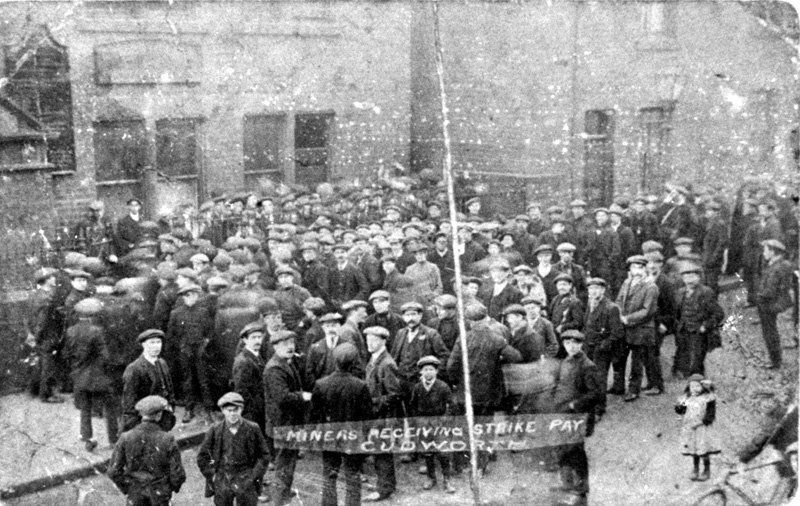
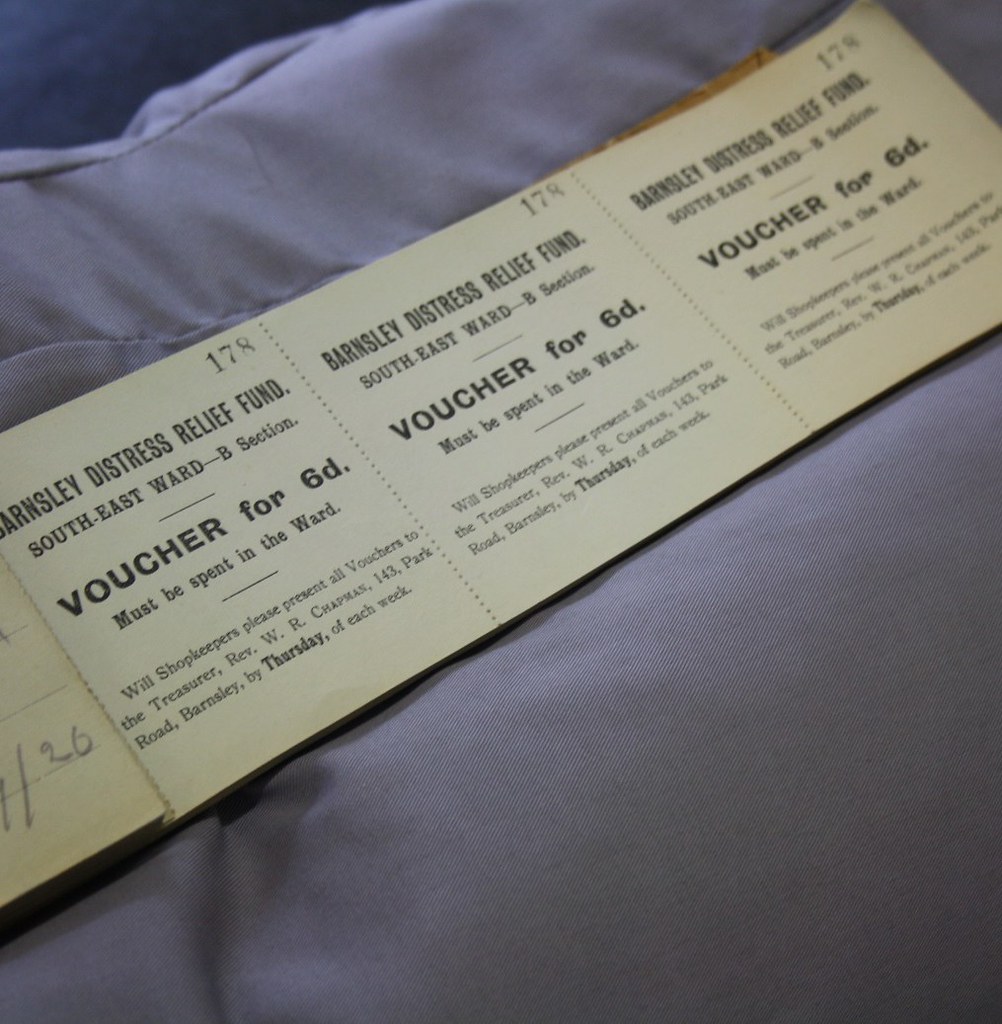
“The 1926 general strike which lasted nine days, from 4 to 12 May 1926. It was called by the General Council of the Trades Union Congress (TUC) in an unsuccessful attempt to force the British government to act to prevent wage reductions and worsening conditions for 1.2 million locked-out coal miners. Some 1.7 million workers went out, especially in transport and heavy industry”
What was that now? A lady’s football team? In 1926?
That must have been quite a novelty. Even now football audiences are only just getting used to seeing women kicking a ball around the football pitch but imagine how must that have been in 1926?
Fast forward to another Barnsley Chronicle article in 1993….
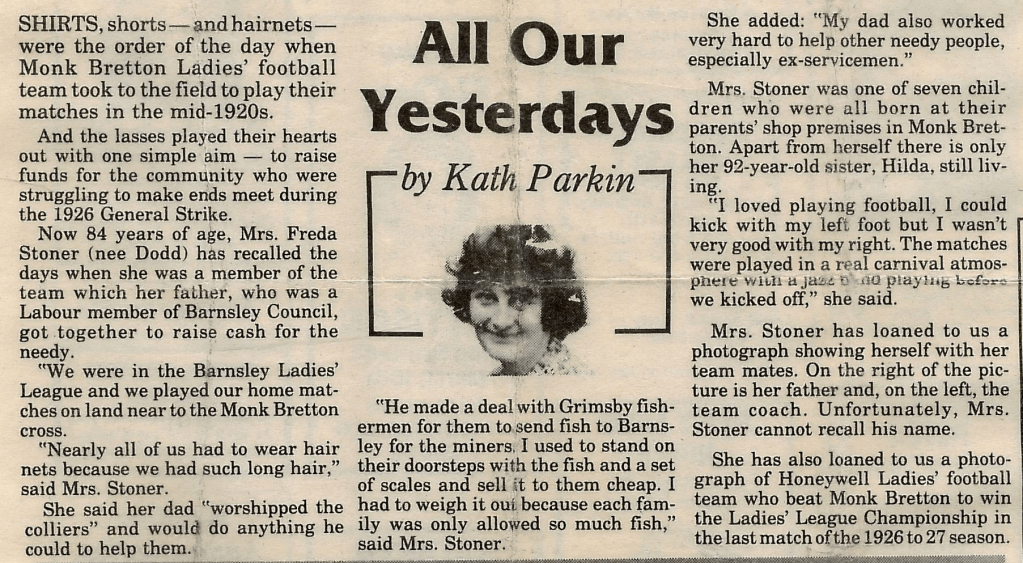
Frieda Stoner is recalling for the “All our Yesterdays” column how, in 1926 at the age of 15, she was part of a ladies football team that her father set up to raise funds for the workers effected by the General strike. The money was to go towards food banks to feed the children of the striking families
Her father was Joseph Henry Dodd, Frieda Stoner was my grandmother and the football team she played for were the Monk Bretton Ladies.
She recalls in the interview, how the football matches had an air of razzmatazz with jazz bands playing before every match to entertain the crowds. She says she enjoyed playing football and she always recalled to us at being surprised that she kicked the ball better with her left foot despite being right handed.
To the casual viewer these matches may have had a carefree feeling to them, but I can assure you, the ladies took them very seriously.
The teams had managers and even secretaries. Indeed, my grandma recalled that the Monk Bretton Ladies had their own trainer called Frank Myers. (just as an aside, It is said that Frank Myers had so many children that he could almost form his own football team!)
They had to design and make their own football shirts. In my Grandmas team they opted for a red body with white detailing. Her mother worked as a seamstress so it was always presumed in the family that she made them for the team.
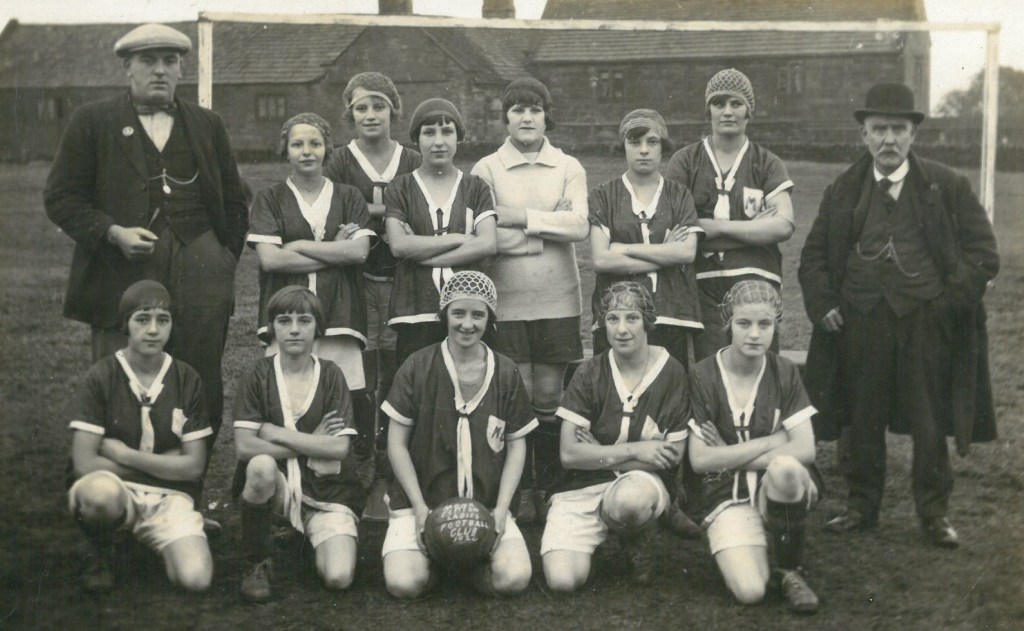
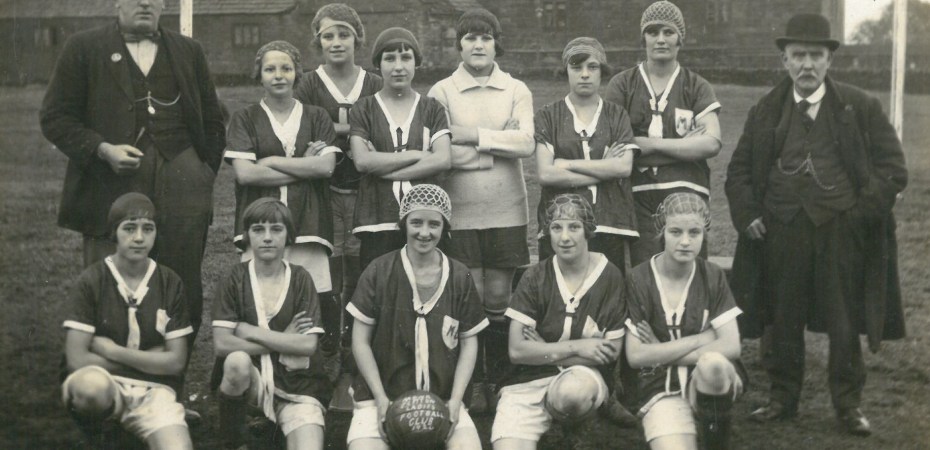
The ladies are arranged like a traditional team. A central player (the Captain maybe?) kneels at the front holding the ball on her lap with both hands. On either side of her are two players keeling with their arms crossed. My grandma is the player on her right
At the back on the far left is Frank Myers the trainer. You can just make out his watch chain across his waistcoat and he is wearing a bow tie and a rather large flat cap. In his hand he is holding a pipe.
On the opposite end at the back is Joseph Henry Dodd. A small man, (they all were in the family) he sports a heavy black coat, a bowler hat and a large moustache
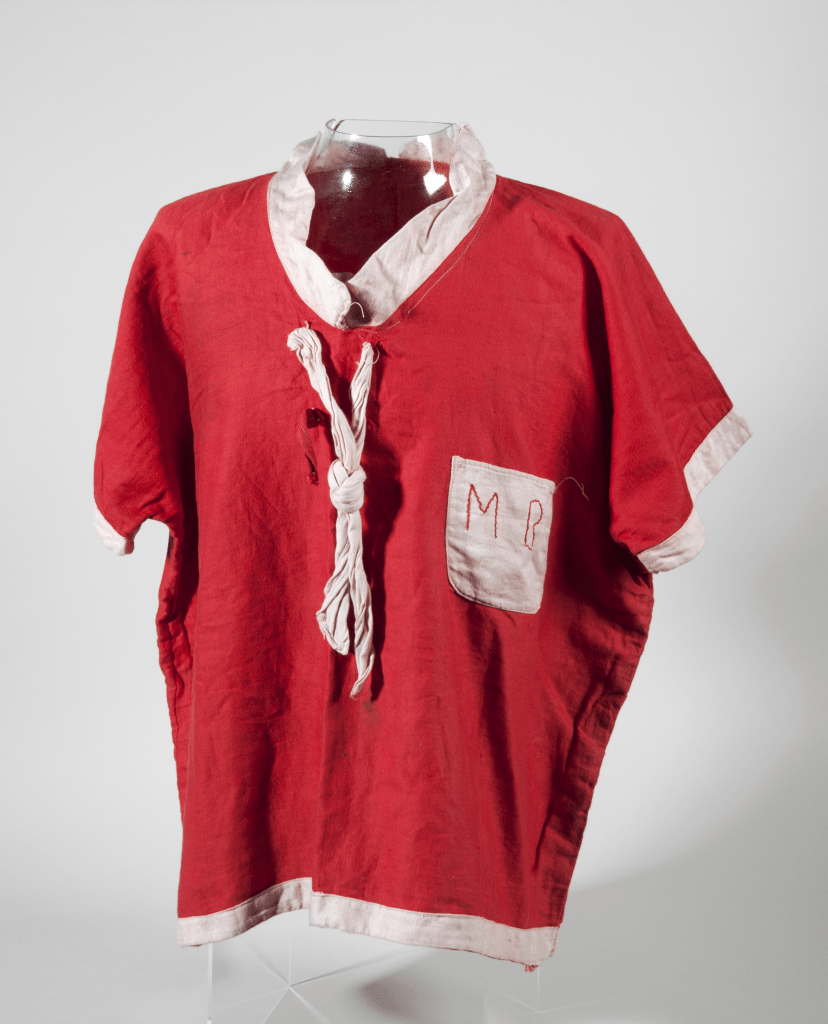
The red colour of the team may have been chosen for a reason. The colour was then, and still is today, the colours worn by Barnsley Football club. But, just as importantly red was associated with the labour party which J H Dodd represented for many years as a councillor.
The Monk Bretton ladies made it through to the final
They ran out onto the pitch in their red shirts and hair nets to face their opponents, The Honeywell ladies.
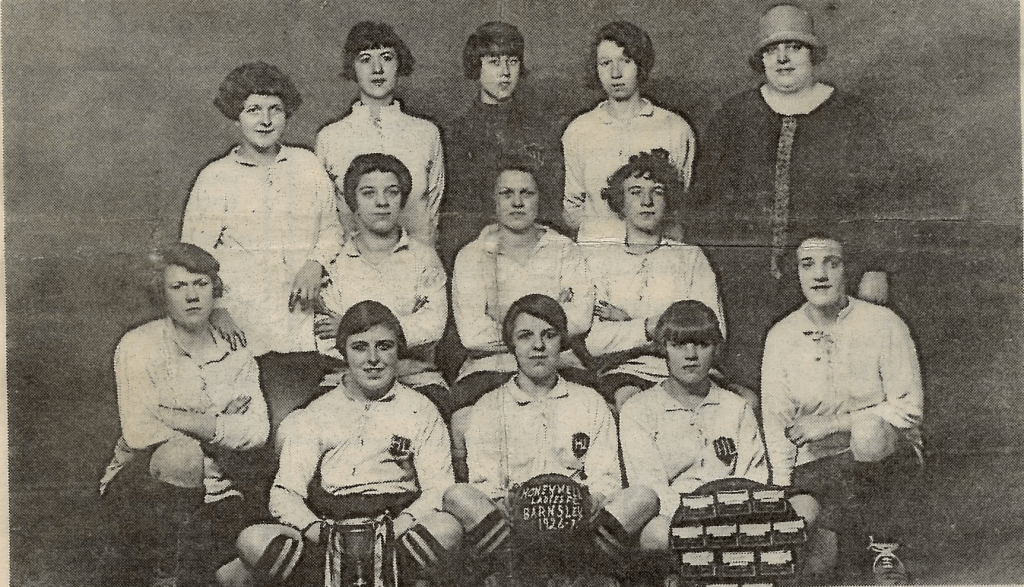
The Honeywell ladies certainly look a formidable team. They wore all white and look like a team of Valkyries. With their no nonsense bobbed hair and white shirts they look the very antithesis of the Monk Bretton ladies.
Imagine what that must have been like to these young women. You are only 15 / 16 years old and Jazz bands are leading you onto the football pitch. You have the honour of not only playing for your village or district but also of helping to feed the families of those worst hit by the strike
In the end the Honeywell Ladies won the final and in the photograph, they are shown with their trophy and commemorative pins
My father found the shirt when they moved home. He asked if he could donate his mums football shirt to the Experience Barnsley Museum in 2018. They had nothing else like it in the collection and we were very pleased to find it had been accepted. In 2020 it was chosen to go on display in the gallery refresh and its now hung for visitors to see.
This in turn has given me a chance to do some research into my Grandmas story and I must tell you I could find nothing about this in the local papers of the time. Not a single article.
The novelty of lady’s football, the good causes, the jazz entertainers were obviously not enough of a story for the papers at the time.
But maybe you will have better luck than me.
So I ask, Does anyone have more to add to this story?
We only know of the 2 teams that played the final. Does anyone know of the other teams, Did your relative play for one of the teams?
Are there any surviving Honeywell ladies’ shirts and winning medals still out there? We never did find that hair net but maybe, just maybe someone still has one tucked away in a drawer. Please get in touch, either when you visit Experience Barnsley Museum or email experiencebarnsley@barnsley.gov.uk
As part of Experience Barnsley’s 10th birthday celebrations we have made a new video tour of the museum which includes Amanda talking about her Grandma’s shirt
Have you read our recent blogs?

The Forgotten Boat Yard of Elsecar
Whilst researching the history around Elsecar, Catherine Roebuck (Visitor Services Assistant) came across a reference to a boat called the ‘North Star’ built in 1855. This was a surprise that boats were built so far from the coast, she then set about trying to find the Boat Yard. Why was there a boat yard? In…

Barnsley Museums & Heritage Trust – 2025: A Year In Review
As we look ahead to what 2026 has to offer, Gillian Thorpe from Barnsley Museums & Heritage Trust re-caps 2025 2025 was a very exciting year for Barnsley Museums and Heritage Trust as it was the year we celebrated our 10th anniversary, and an event was held at Barnsley College to celebrate this milestone. 2025…
Celebrating Volunteer Impact: Highlights from Barnsley Museums
Volunteers are amazing. They give their time, energy, and commitment to make our museums and heritage sites better for everyone. In doing this they have created a community across five distinct but connected places. They have done incredible things supporting Barnsley Museums and while we can’t cover everything, here are some highlights from 2025. Pathways…
 Barnsley Museums Blogsite